WEALTH & OTHER VICES #7. INSIDE THE COMMANDING HEIGHTS

In this issue of WEALTH & OTHER VICES we examine the emerging investment opportunities beyond AI developers themselves, from the infrastructure and financial systems that could capture the technology’s economic value to forests, farmland and other forms of natural capital attracting institutional money. We also look at the changing economics of wellness, where longevity, diagnostics, recovery and personalised health are transforming consumer behaviour and creating new premium markets. Away from the markets, we discover an extraordinary Renaissance residence in the Loire Valley that offers something increasingly difficult to buy: a genuine piece of history. And, to finish, we bring you a few conversations worth your time, exploring investment strategy, the building of financial empires, permanent capital and the unexpected relationship between artificial intelligence and psychotherapy.


Membership Required

You must be a member to access this content.

View Membership Levels

Already a member? Log in here

WEALTH & OTHER VICES #6. SOUTH KOREA’S HIDDEN POTENTIAL

This issue of WEALTH & OTHER VICES explores where overlooked value may be hiding and why conventional investment wisdom can miss it. We look at South Korea’s curious two-speed stock market, where the AI boom has lifted a handful of semiconductor giants while thousands of profitable businesses remain deeply undervalued — and examine whether corporate reforms could finally unlock that potential. Elsewhere, we investigate why Singapore’s wealthy keep more than 70% of their assets in cash, and what this reveals about the relationship between liquidity, trust and the reluctance to put capital to work. We also consider a different kind of wealth: the growing appeal of wellness experiences built around music, movement and the pleasure of letting go, rather than endless self-optimisation. To finish, we take a closer look at two extraordinary watches that turn the oil industry into mechanical theatre, and select a few conversations worth your time — on old money, fine wine, the value of intelligence and the less visible side of success.

Membership Required

You must be a member to access this content.

View Membership Levels

Already a member? Log in here

WEALTH & OTHER VICES #5. DEATH IS HAVING A VC MOMENT

This issue of WEALTH & OTHER VICES explores the business and pleasures of wealth beyond the obvious. We look at the growing investment opportunity in death, inheritance and the transfer of fortunes, and what wealthy families should do to ensure their legacies survive them. We examine how global asset management is becoming increasingly concentrated in the hands of a few dominant platforms, reshaping the opportunities available to investors and the businesses competing for their capital. We also consider a more personal question: why friendship may be one of the most neglected assets in the lives of successful people, despite its importance to a life well lived. In THE VICE, we venture into Asia’s increasingly adventurous world of luxury perfumery, where exotic ingredients and distinctive cultural traditions are challenging the conventions of European fragrance. And in STEAL SOME TIME, we bring you a selection of things worth watching, from remarkable Australian architecture to the thinking of one of global finance’s most influential leaders and the story of an ambitious French investment firm. Across markets, relationships and the finer pleasures of life, this issue asks what wealth makes possible, what it puts at risk, and what remains valuable when money is no longer the main constraint.

Membership Required

You must be a member to access this content.

View Membership Levels

Already a member? Log in here

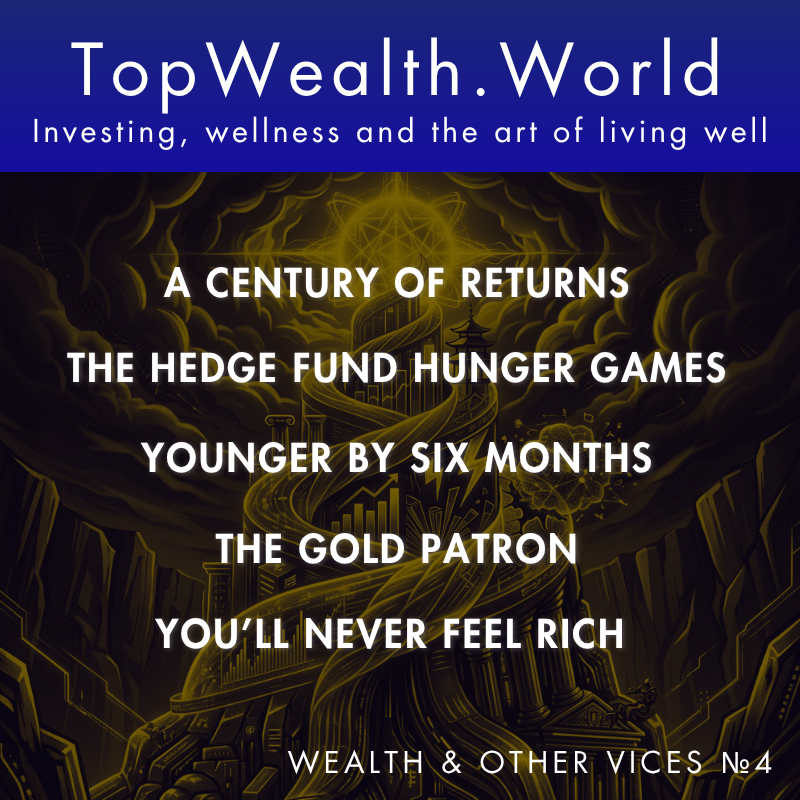
WEALTH & OTHER VICES #4. A CENTURY OF RETURNS. A LIFETIME OF LESSONS.

This issue explores how wealth is built, managed and redefined in a world where the rules of money, success and longevity are becoming increasingly complex. We look at what a century of market history can teach us about compounding, risk and the limits of forecasting; why even exceptional investors are struggling to build independent businesses in an industry dominated by giants; and how the pursuit of a longer life is turning ageing into a measurable, competitive pursuit. We also examine a different kind of value creation, as a company draws on its industrial expertise to help artists transform precious metals into works of cultural significance. From the long game of capital to the personal ambition to outlast time, this issue asks what wealth really means — and what remains valuable beyond the numbers.

Membership Required

You must be a member to access this content.

View Membership Levels

Already a member? Log in here

Ray Dalio on navigating a new financial order: debt crises, AI hype, and global realities

In a recent interview, Ray Dalio argues that the global economy is approaching a major turning point, with rising government debt, higher interest costs and growing geopolitical tensions putting pressure on markets. He is also cautious about the AI boom, drawing parallels with past bubbles and suggesting that the bigger long-term winners may be companies that use AI well, rather than those simply selling the technology. His advice: look beyond the latest market excitement, stay diversified and prepare for a more fragmented global economy. His main ideas:

Read More

London’s tax suicide: the flight of its biggest taxpayers and a $160 billion loss

The mass exodus of ultra-wealthy people from Britain has put around $160 billion of wealth on the move, as wealthy residents and foreign elites increasingly shift their fortunes and financial ties overseas. The main reasons are the new fiscal reforms introduced by the Labour government and the abolition of long-standing tax privileges, combined with persistent fears of further tax increases and tighter financial rules. As a result, London is gradually losing some of its appeal as a leading global financial centre, dealing a significant blow not only to tax revenues but also to the luxury property, hospitality and consumer economy that depends so heavily on wealthy residents.

Membership Required

You must be a member to access this content.

View Membership Levels

Already a member? Log in here

Bill Ackman’s simple rules for money and investing

Bill Ackman is a famous American billionaire investor and founder of the hedge fund Pershing Square. He is known on Wall Street for making big, bold bets on major companies, helping turn around struggling businesses, and using his financial success to fund cutting-edge medical research and charitable causes. Investing money can feel confusing and risky, but Bill Ackman keeps his strategy straightforward. He believes in buying solid, reliable companies that make real cash, holding them for many years, and staying away from dangerous bets like short selling where you can lose unlimited money. He warns that artificial intelligence will quickly wipe out weak businesses, and he advises regular people to avoid picking individual stocks and just buy low cost index funds instead. These core ideas show how Ackman protects his capital, avoids common Wall Street traps, and builds lasting wealth.

Read More

Gold Is Having a Very Strange Year

Gold is having one of those years when almost every explanation seems to be true at the same time. It has been one of the great trades of 2026, then suddenly looked horribly expensive, then fell sharply, while some of the biggest buyers in the world simply carried on buying it. The usual gold story — lower rates, weaker dollar, inflation fears, geopolitical anxiety — is still there, but it no longer seems big enough to explain what is actually happening.

Read More