

The Shift Toward Preventive Longevity, Screenless Technology, and High-Fashion Biometrics
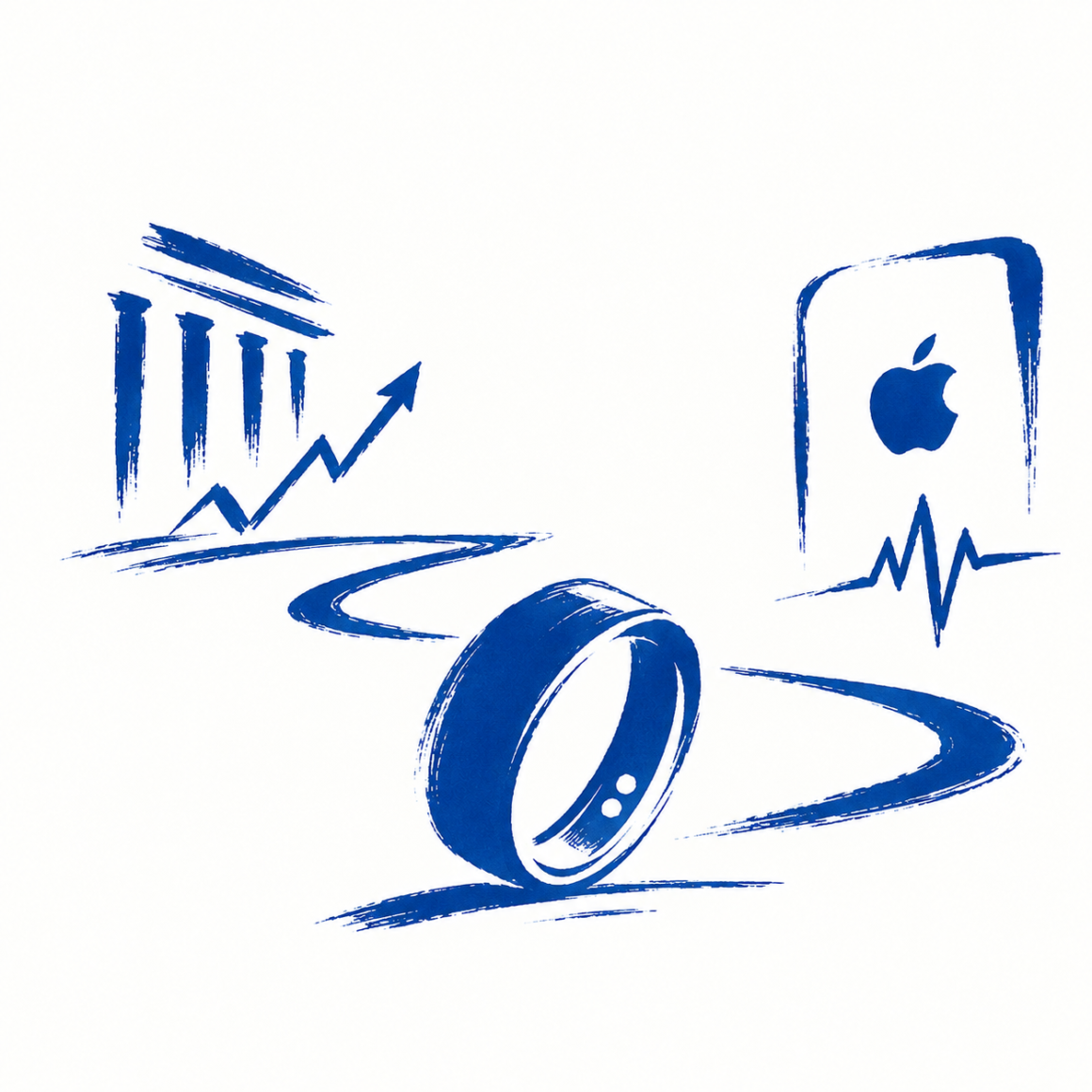
While global markets remain fixated on the artificial intelligence race, a quiet yet fundamental transformation is unfolding in personal health. Finnish brand ŌURA is preparing for its Wall Street debut with a record valuation of $15.6 billion, while Apple is secretly developing its first screenless wearable device. Prime body real estate is rapidly shifting from the wrist to the finger, turning ambient biometrics into a natural element of daily comfort and high quality of life. In this article, we broke down how preventative medicine, cutting-edge technology, and fine jewelry styling have shaped a new $9.8 trillion market.
- An Elegant Business Model: How a modest titanium band built a subscription service with an 89% gross margin and jumped ahead of AI giants in the IPO queue;
- The Femtech Engine: Why a dedicated focus on female physiology rewrote the rules of the wearable tech market and captured a 71% female audience;
- The Ringscape Phenomenon: How microelectronics entered the Quiet Luxury wardrobe and inspired jewelry houses to design precious ‘ring jackets’ for smart rings;
- The Analog Wellness Philosophy: Why the future belongs to ‘quiet’ technologies that safeguard longevity without digital clutter or screen-induced fatigue.
This article is based on an S-1 financial analysis, Bloomberg insights, reports from the Global Wellness Institute, Deloitte, and Rock Health, as well as interviews with ŌURA leadership for Vogue.
The New Gravity of Health: Well-being as the Ultimate Personal Asset
In modern society, a profound mental revolution has taken place. The concept of high quality of life and personal status has decisively shifted from the conspicuous ownership of material objects—exotic automobiles or collectible timepieces—to absolute control over one’s biological resource. Health is no longer perceived as the passive absence of diagnosis. Today, it is a dynamic, daily managed capital that dictates cognitive clarity, decision-making stamina, and sustained life energy.
This evolution is anchored in global tectonic shifts. According to research by the Global Wellness Institute (GWI), the global wellness market has reached an impressive $6.8 trillion. With an annual growth rate of roughly 8%, it is confidently advancing toward $9.8 trillion by 2029, forming over 6% of global GDP and equivalent to 60% of global healthcare expenditures. Direct consumer spending on preventative medicine and well-being maintenance, which crossed $1 trillion, is projected by Deloitte analysts to double and surpass $2 trillion by 2030. Mindful individuals no longer wait for symptoms to appear—they choose continuous preventative control.
The culture of bio-monitoring has long outgrown the niche of Silicon Valley biohackers. According to reports from research firm Rock Health, 57% of American adults already own at least one wearable or connected health device. Meanwhile, McKinsey & Company Senior Partner Jessica Moulton highlights that 84% of consumers name wellness as their top personal priority, with the younger generation of Millennials and Gen Z accounting for over 41% of all annual wellness expenditures. Investing in one’s well-being has become a foundational line item in family budgets, where technological comfort seamlessly meets personal care.
However, despite the massive scale of this movement, Rock Health researchers record a distinct «Digital Divide». Smart gadgets priced at $300–$500 with a mandatory monthly subscription currently remain the privilege of active and affluent urban dwellers engaged in self-optimization. At the same time, older adults and patients with severe chronic conditions—those for whom continuous monitoring is vital—remain sidelined due to financial and technological barriers. As a result, the smart ring has transformed into an early-adopted badge of access to the medicine of the future.
The ŌURA Phenomenon: How a Titanium Ring Outshone AI Giants on Wall Street
The defining symbol of this new era was an event that shook financial markets. Finnish startup ŌURA, which began in 2015 with a modest crowdfunding campaign by co-founders Petteri Lahtela, Kari Kivelä, and Markku Koskela, filed its S-1 registration statement for an IPO targeting a valuation of up to $15.62 billion (offering 50 million shares at $40–$44 per share to raise up to $2.2 billion). At a moment when public listings for major artificial intelligence developers were stalled for years, a discreet titanium ring weighing mere grams unexpectedly became the most discussed public offering on Wall Street.
The secret behind this frenzy is revealed in a detailed financial analysis by Halle Tecco, MPH, MBA, a venture investor and founder of Rock Health. For the first nine months of FY2026, ŌURA’s revenue reached $1.21 billion (demonstrating +74% YoY growth), surpassing the entire previous full year ($908 million). But the key revelation of the filing was the masterclass of its two-component business model.
| Financial Metric (FY2026 YTD) | Strategic Significance & Value |
| Total Revenue (9 Months) | $1.21 Billion (+74% YoY growth) |
| Hardware Sales (Rings) | $974 Million (80% of revenue, 46% margin, 3.1M rings sold) |
| Membership Subscriptions | $241 Million (20% of revenue, 89% gross margin, +121% YoY) |
| Blended Gross Margin | 55% (Operating Net Income: $60.8M, Adj. EBITDA: $106.7M) |
| Unit Economics (LTV / CAC) | Gross Profit LTV ~$560 vs. CAC $93–$145 (LTV/CAC = 4x–6x) |
| Active Subscriber Base | 5.7 Million members (+96% YoY, 85% 12-month retention) |
ŌURA combined hardware sales with a high-margin recurring service. Hardware generated $974 million (~80% of revenue) at a 46% margin. However, the true holy grail was the application subscription costing $5.99/month ($69.99/year): it brought in $241 million with an 89% gross margin. This lifted overall company gross margin to 55%, delivering $60.8 million in net income and $106.7 million in adjusted EBITDA.
As Halle Tecco calculated, because 85% of users continue paying for the service after a year, the average customer lifespan exceeds 6.7 years. Gross profit lifetime value (LTV) per user reaches ~$560 against a customer acquisition cost (CAC) of $93–$145. Such an LTV/CAC ratio of 4x–6x is characteristic only of elite software platforms. Investors saw in ŌURA not merely a jewelry maker, but a technological moat fortified by 42 billion hours of longitudinal biometric data.
Key financial details highlighted by Halle Tecco reinforce the maturity of the enterprise:
• Operating Profitability vs. Paper Accounting: Alongside $60.8 million in net income, filings record a $924.3 million non-cash paper loss attributable to common stock due to a one-time technical revaluation of preferred stock ahead of the listing, involving zero cash outflow.
• Investor Strategy: Of the $2.2 billion raised, ~$1.53 billion goes to selling shareholders (notably Forerunner Ventures locks in profits by selling its full 28.7 million share stake for ~$1.2 billion). Meanwhile, anchor institutional investor Fidelity (FMR LLC), holding 10.9% ($765M+ invested), is not selling a single share, demonstrating absolute faith in long-term growth.
• Professional Management: The company’s founders completely sold their stakes back in 2020–2021. Today the brand under Chairman of the Board David Shuman is managed by experienced CEO Tom Hale and Chief Design Officer Miklu Silvanto, who have proven their ability to scale the business into billions.
The Battle for Body Real Estate: Why Apple Is Betting on Screenless Silence
The reaction of tech giants to the financial breakthrough of smart rings was immediate. Senior Bloomberg Technology Reporter Mark Gurman revealed an insider report: Cupertino, under the direct stewardship of Apple CEO Tim Cook and Senior Vice President of Services Eddy Cue, is secretly developing its own screenless wearable tracker. Apple’s concept is a lightweight sensor pod or textile wristband completely devoid of a display and distracting notifications.
This move marks an epochal shift. Since 2015, the tech industry convinced the world of the superiority of smartwatches. Today, however, body real estate is being redistributed—shifting focus from wrist to finger. According to analyst firms IDC and Counterpoint Research, while global smartwatch shipment growth slowed to +6%, the smart ring segment is demonstrating explosive growth between +49% and +77% per year. According to an LA Times report, smart ring penetration in the US has already reached 12% of households (15 million families with an installed base of 26.1 million rings).
| “The primary driver of the shift from wrist to finger is psychological screen fatigue. Entrepreneurs and active individuals no longer want another source of blue light and notifications on their wrists. A ring delivers passive biometrics: thin skin and digital arteries yield clinical-grade accuracy for heart rate, HRV, and body temperature with 7+ days of battery life and continuous wear of 23.8 hours per day.” — Industry Insight on Screenless Silence |
The Femtech Engine: How Women’s Health Rewrote Consumer Tech Rules
For a long time, the world of wearable electronics was built by men for men: early devices measured sports metrics, distance tracking, and calorie burn. ŌURA achieved a breakthrough by recognizing a simple truth: women are the primary «Chief Medical Officers» of their families and the most proactive consumers of wellness.
Financial filings reveal that 71% of ŌURA’s paid users are women. The brand’s female user base grew at a compound annual rate of 143% CAGR, with direct sales to women surging 250% over the last year. The secret behind this phenomenon was revealed in a Vogue interview by ŌURA CEO Tom Hale: the male body is relatively static, whereas the female body navigates continuous 30-day hormonal cycles, pregnancy phases, and menopause.
| “We saw that women’s health was vastly underserved. A woman’s body changes every 30 days, whereas my physiology is relatively static. From optimizing workouts around cycle phases to pregnancy planning, this was an untapped frontier. We doubled down on women’s health, and women flooded to ŌURA, sending our growth through the roof.” — Tom Hale, CEO of ŌURA (Vogue Interview) |
Market analysis of Rock Health reports reveals an intriguing paradox: across the broader global smart ring market, men still represent a slight majority (54% men vs. 46% women), and across all wearable devices, ownership is split almost evenly (58% women vs. 57% men). This proves that ŌURA’s triumph was not the result of automatic category expansion, but a conscious strategic decision to become the premier platform for women’s health.
Rock Health research shows that women track more health metrics on average than men (3.11 vs. 2.85). Yet women express deep skepticism toward impersonal algorithms, chat-bots, and AI services: only 15% of women trust AI in health decisions (compared to 23% of men). Women demand transparent, evidence-backed clinical data that they can share with real physicians (71%) and loved ones (51%), rather than an AI «black box».
By focusing on cycle tracking, integrating with the FDA-cleared contraceptive app Natural Cycles, providing pregnancy analytics, and launching a specialized perimenopause module, the brand won unwavering trust. As Tom Hale noted in Vogue, particularly telling is the behavior of Gen Z (women aged 18–25), who became the fastest-growing buyer category. For a young audience, purchasing a stylish ring for $349–$499 and paying a recurring subscription became a natural expression of self-care and personal stewardship over longevity.
The Art of the Ringscape: Bridging Biometrics and Fine Jewelry
Parallel to technological transformation came an aesthetic revolution. Harper’s Bazaar Arabia Fashion and Jewelry Editor Charlie Boyd notes that the smart ring decisively outgrew its identity as a utilitarian «gadget» and entered the fine jewelry wardrobe as a centerpiece of modern styling—a phenomenon dubbed the «rings-cape».
Behind this shift lies a deliberate design philosophy. Hiring Miklu Silvanto—former lead Apple designer who spent nearly a decade under legendary Jony Ive—as Chief Design Officer allowed the company to rewrite design codes. Instead of rigid industrial design rules, ŌURA is crafted at the intersection of high fashion and fine jewelry.
| “What we create sits precisely at the intersection of fine jewelry, fashion, and industrial design. Most consumer electronics follow strict utility rules. We deliver peak technological functionality, but in a form that seamlessly expresses individual jewelry style.” — Miklu Silvanto, Chief Design Officer at ŌURA (ex-Apple Lead Designer) |
The launch of a hypoallergenic ceramic collection (ŌURA Ring 4 Ceramic at $499), elegant metallic tones like Deep Rose and Gold, and the sell-out success of the limited-edition Gucci x ŌURA collaboration ($950) proved that luxury consumers view the smart ring as quiet luxury (Quiet Luxury). It conveys a subtle, non-verbal signal: its owner values style and actively invests in health.
However, at the intersection of fine jewelry and microelectronics lies the «High Jewelry dilemma». In a Vogue interview, Tom Hale candidly explained why the brand hesitates to produce $20,000 solid gold and diamond-encrusted rings. Any lithium-ion micro-battery inevitably degrades within 3–5 years of use. Selling a client a high jewelry masterpiece with a limited lifespan contradicts the fundamental tenet of fine jewelry’s everlasting value.
| “When a client buys a $20,000 piece of high jewelry, they expect it to last for generations. But a lithium-ion battery in a smart ring inevitably degrades after 3 to 5 years. Creating a $20,000 piece of technology with a finite lifespan creates a fundamental conflict with the essence of fine jewelry.” — Tom Hale, CEO of ŌURA on the High Jewelry Dilemma (Vogue Interview) |
This technological barrier spawned a new independent market. Fine jewelry brands (such as Kimai and Ring Concierge) began producing delicate 18-karat gold and diamond bands—so-called «ring jackets». Designed to fit over the titanium ŌURA body, they transform the gadget into a cluster of fine gemstones. When the internal microchip eventually becomes obsolete, the owner simply replaces the titanium core while retaining the precious jewelry setting.
Analog Wellness: Balancing Digital Data and the Nervous System
In the race for continuous bio-monitoring, a delicate psychological line exists—so-called «over-optimization», where metric tracking becomes a source of anxiety. Global Wellness Summit Chair and CEO Susie Ellis and Wellness Strategist Amy McDonald highlight an important counter-trend: «Analog Wellness» and a focus on nervous system regulation. Consumers no longer want devices that dictate rules or induce stress with low scores. They desire a gentle, ambient advisor that quietly helps restore balance.
This is where the smart ring format excels: it collects data passively and transforms billions of signals into a single intuitive Readiness Score. Furthermore, data privacy remains paramount. Governed by strict European GDPR regulations and American HIPAA standards, ŌURA maintains an unyielding stance: biometric data belongs exclusively to the individual, not to employers or insurers.
Investing in Your Primary Asset
The evolution of smart rings and their resounding breakthrough on financial markets is not merely a story about a successful tech startup. It is a clear reflection of shifting human priorities:
1. Health as the Ultimate Form of Luxury: Investments in preventative longevity, mental balance, and continuous bodily awareness have become the defining hallmarks of high quality of life.
2. Triumph of Ambient Technologies: Screen-based devices yield to ambient, passive sensors that care for the individual 24/7 without pulling them away from real life.
3. Harmony of Aesthetics and Utility: Technological devices no longer compete with personal style. They integrate into fine jewelry, expressing taste and individual values.
Investing in one’s well-being and proactive physiological control is the single best investment, yielding guaranteed returns in energy, mental clarity, and longevity. The future belongs to technologies that make us stronger while remaining quiet, elegant, and unobtrusive.