

There are cheaper ways to get from Paris to Venice. There are faster ones, too. This is precisely the point. The Venice Simplon-Orient-Express is still very much alive in 2026: a seasonal series of luxury journeys rather than a railway service you use because you need to get somewhere. The numbers are almost wonderfully absurd. A classic Paris–Venice journey in 2026 starts at about £4,275 per person in a Historic Cabin. Longer itineraries can run to nearly £20,000 per person. The train is not a permanent scheduled service either; it operates as a seasonal series of luxury journeys, moving between Paris, Venice, Vienna, Prague, Florence, Rome, Portofino and, on longer trips, Istanbul. The classic Paris–Venice journey leaves in the afternoon and arrives the following afternoon, taking roughly one night.
And what, exactly, are you getting for that money? Seventeen historic carriages at maximum length, most dating from the 1920s and 1930s, restored with the sort of craftsmanship that modern hotels tend to put behind glass and call heritage. There are restaurant cars, a bar, sleeping cars and, since 2025, L’Observatoire — an entire sleeper carriage designed by the French artist JR, complete with a bedroom, bathroom, lounge, library and hidden tea room. The train’s Art Deco interiors involve the work of names such as René Prou and René Lalique; some of the original carriages have histories almost as elaborate as the people who travelled in them. One sleeping car was used as a wartime brothel. Another carried King Carol II of Romania and his mistress out of the country in 1940.
But the real story begins with a rainy afternoon in Monte Carlo.
In 1977, American businessman James Sherwood, founder of the transport company Sea Containers, went to a railway-carriage auction largely looking for bargains. Among the lots were five original 1920s carriages. Princess Grace had actually travelled in one of them from Nice to Monte Carlo that morning for brunch. Sherwood bought two sleeping cars for $104,000. Then he became obsessed. Over the next five years he searched railway sidings, museums and forgotten corners of Europe for the lost carriages of the old Orient Express. More than 20 additional coaches were eventually found, some rusting in the snow and some barely recognisable beneath decades of neglect. Sherwood ultimately put around $20 million into acquiring the rolling stock, restoring it, assembling the operation and getting the thing back on the European railway network.
On 25 May 1982, the resurrection finally happened. The inaugural journey left London Victoria at 11:44 in the morning, with Liza Minnelli, the Duchess of Westminster and assorted royalty, celebrities and society figures aboard. The British Pullman carried the passengers to Folkestone; they crossed the Channel and boarded the restored Orient Express carriages for the continental journey to Venice. Dinner was consommé double au sherry, salmon mousse, lamb, cheese and pear soufflé. The pianist played in the Bar Car until 5am. Croissants arrived in Lausanne for breakfast. It was not exactly transport. It was theatre on wheels.
The original Orient Express had, of course, been doing something similar long before Sherwood was born. The first service left Paris in 1883, connecting Western Europe with Constantinople and eventually Istanbul. The golden age of the train produced an extraordinary cast of passengers and stories, and Agatha Christie became perhaps its most famous literary passenger. She later described it as “the train of my dreams” and wrote about her fascination with looking out of the window at “an entirely different world.” She travelled on it repeatedly, even carrying her typewriter, and an incident in which the train was stranded during a storm helped feed the imagination behind Murder on the Orient Express.
The original service finally disappeared in the age of aviation. Sherwood’s version brought it back in a different form. The business eventually became part of the Orient-Express Hotels group, which was renamed Belmond in 2014. Then came the truly modern luxury twist: LVMH acquired Belmond in 2019 for an enterprise value of $3.2 billion. So today’s Venice Simplon-Orient-Express is not merely an eccentric heritage railway. It is an LVMH luxury asset built around selling an experience, a story and a particular relationship with time. Belmond itself now operates a portfolio of luxury hotels, trains and travel experiences across the world; the VSOE is one of its most recognisable expressions of what it calls “slow luxury.”
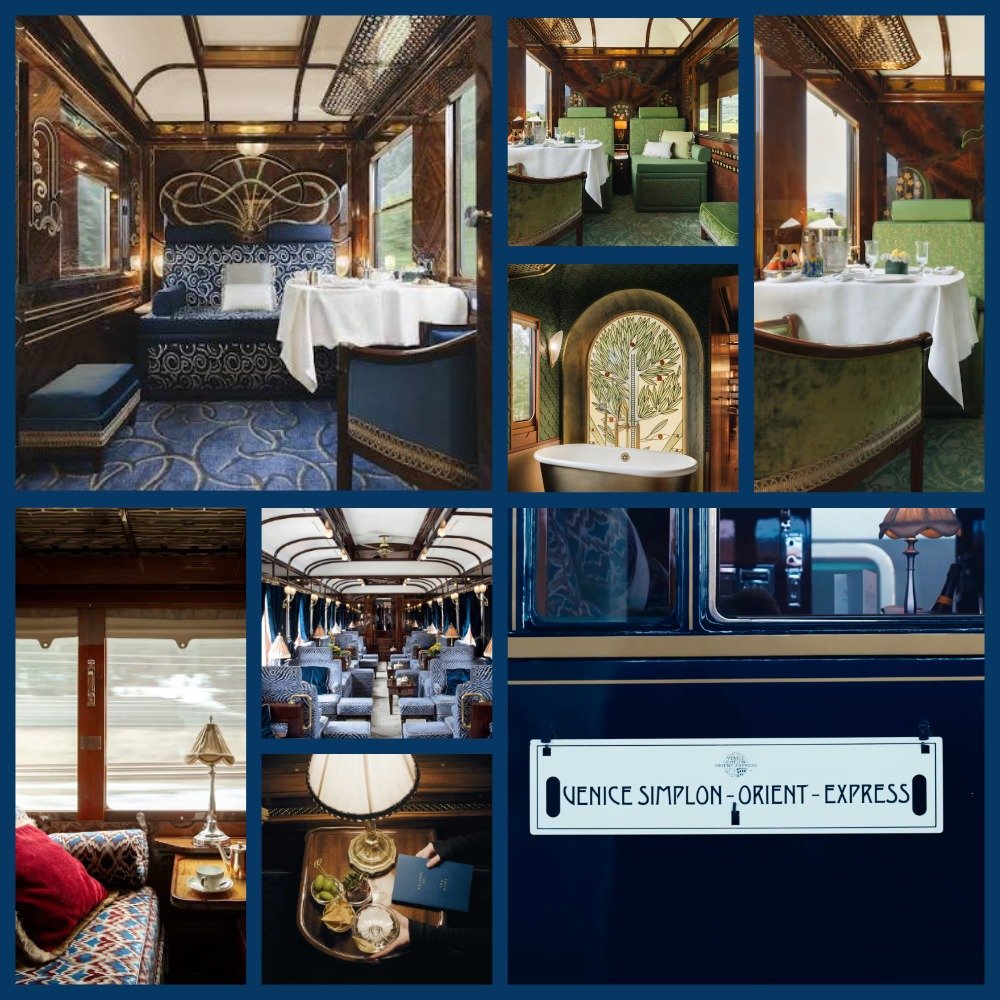
There is something deliciously misleading about that phrase, though. Despite the whole “slow luxury” idea, the train isn’t actually crawling across Europe. It is a proper mainline train, averaging around 130 km/h and authorised to travel at up to 160 km/h. Which is fast enough. The point is that you don’t care how fast you’re going. Nobody is checking the speedometer. Nobody is trying to answer email between Charles de Gaulle and Marco Polo. Nobody is calculating whether the journey could have been done in three hours instead of seventeen. You are having dinner. And then breakfast. And then another coffee. And then perhaps a walk through seventeen carriages simply because you can.
This is what makes the VSOE such a perfect vice for 2026. Modern life has spent decades eliminating the useless parts of travel. Faster check-in. Faster trains. Faster planes. Digital boarding passes. Airport lounges designed to make waiting disappear. Wi-Fi so that even 35,000 feet above the ground can be turned into another office. Everything has been optimised for arrival.
The Orient Express makes a very different proposition: what if getting there is the thing you bought?
You pay thousands of pounds to spend a night doing almost nothing useful. You dress for dinner because somebody has thoughtfully given you a reason to. You drink Champagne while the landscape changes outside the window. A steward takes care of your cabin. Someone else worries about the timetable. The train crosses borders and mountains and Europe continues to exist outside the glass, while inside, for a few unusually expensive hours, the normal pressure to optimise yourself disappears.
That is why the price is almost beside the point. You aren’t paying £4,275 for a bed, a meal or a particularly elaborate way of getting from A to B. This is the Friction Premium in reverse: the friction is no longer something to eliminate. It becomes the experience itself. The waiting, the dressing up, the ceremony, the slowness — all the things modern life has spent decades trying to remove — become the luxury. The friction isn’t a bug. That may be the real vice. Not the Champagne, the caviar or the marquetry. Paying an absurd amount of money for the inconvenience of having nowhere else to be.
We are entering an era in which AI promises to make almost everything faster, cheaper and easier. It will book the restaurant, compare the flights, rearrange the itinerary, answer the email and perhaps eventually organise the entire trip without bothering you about any of it. Friction is becoming something technology is increasingly good at removing.
The VSOE does the opposite.
The richest thing you can buy may be more life. But every now and then, perhaps the real luxury is buying a night in which you don’t have to make any use of it.
From £4,275 to £20,000 per person per night for nowhere else to be. We’ll take it.