

For affluent wealth owners, acting on the $9 trillion longevity megatrend requires a three-part playbook: systematically rebalance portfolios and wealth structures for extended lifespans; deploy capital into high-growth sectors like wellness real estate ($464bn), wellness tourism (+30% growth by 2028), and biotech; and optimize personal health span using advanced diagnostics—DNA sequencing, epigenetics, and metabolomics—combined with cellular therapies and daily lifestyle discipline. This pivots capital from material accumulation toward extended vitality, family well-being, and high-quality life experiences.
As global lifespans outpace health spans, capital is undergoing a structural shift from material accumulation to biological optimization. Synthesizing data from the United Nations, the Global Wellness Institute, Julius Baer, and Clinique La Prairie, this briefing by Financial Times outlines how affluent investors and business owners can navigate the $9 trillion longevity megatrend—from financial portfolio restructuring and medtech investments to personal diagnostic protocols.
1. The Demographic Flip: “Health Span” Is the New Core Metric
The world is undergoing a profound structural shift as life expectancies rise while birth rates fall. The United Nations projects the global population to reach 9.8 billion by 2050, with adults aged 65 and older accounting for more than 25% of the population across Europe, North America, and Asia-Pacific. By 2080, individuals aged 65 and over (2.41 billion) will officially outnumber children under 18 (2.25 billion) worldwide.
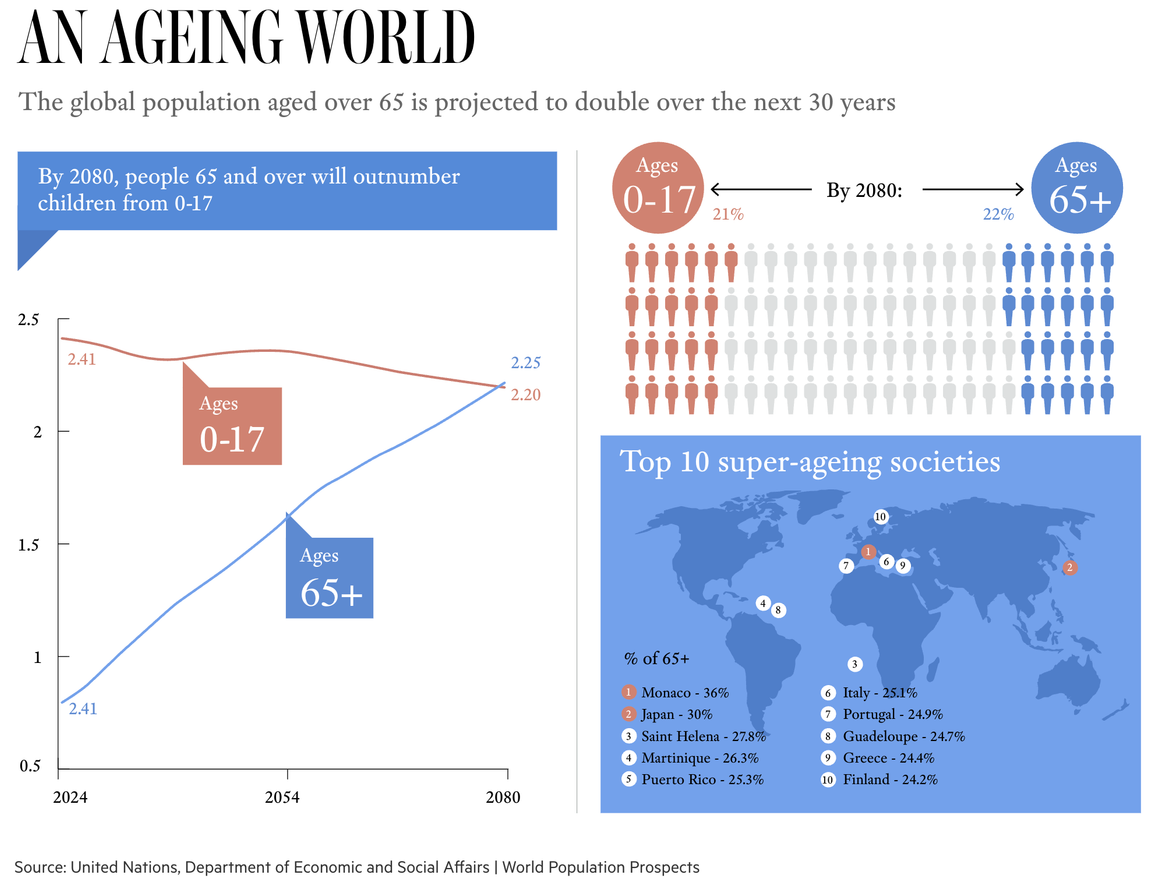
Super-ageing societies are already showing where the rest of the world is headed: Monaco leads with 36% of its population over 65, followed by Japan at 30%, Italy at 25.1%, Portugal at 24.9%, Greece at 24.4%, and Finland at 24.2%. In response, sophisticated wealth owners are shifting their focus from simple “lifespan” (total years lived) to “health span”—the number of years lived in active, disease-free vitality.
“One of the first realizations, more than a decade ago, was that there’s more to longevity than just living longer. Modern medicine tends to fixate on lifespan, but half of the longevity equation is on the healthspan side.” — Peter Attia
“Health is sometimes called the new wealth, and we see that mindset fuelling demand for longevity programmes, personalised medicine and age-defying therapies.” — Simone Gibertoni, CEO of Clinique La Prairie
2. The $9 Trillion Megatrend: Where Capital Is Flowing
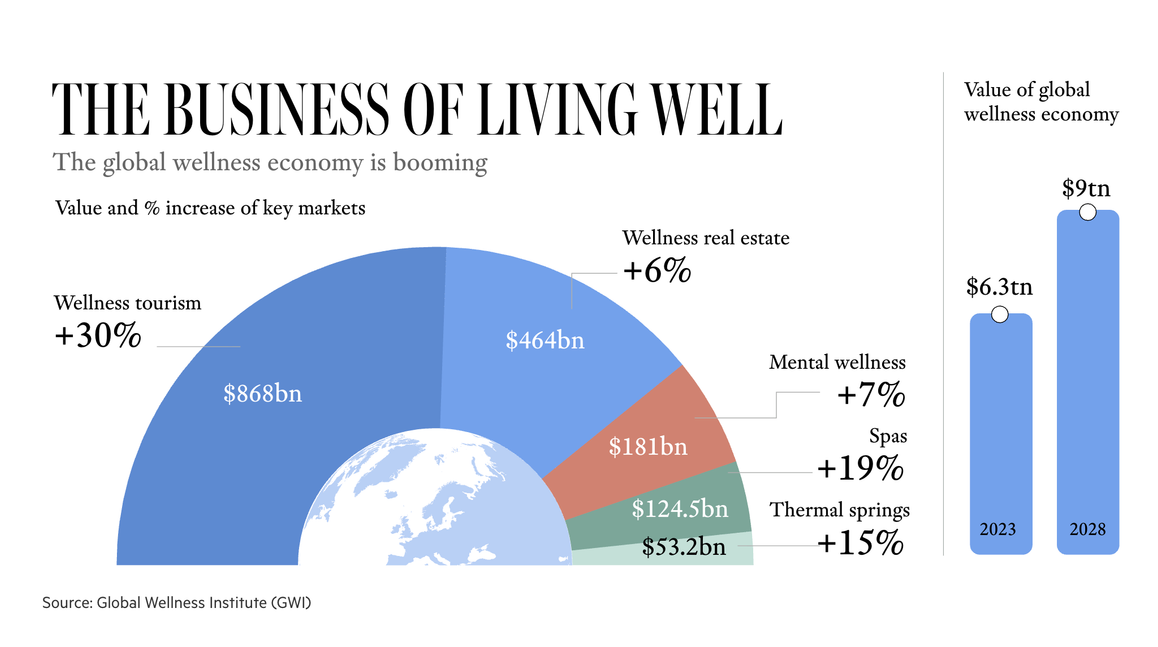
The commercial ecosystem around living longer and better is expanding rapidly. The Global Wellness Institute reports that the global wellness economy reached $6.3 trillion in 2023 and is projected to hit $9 trillion by 2028. Within this ecosystem, the longevity-focused market alone is set to reach $610 billion by 2026.
Specific sub-sectors present clear institutional and private investment avenues based on projected growth by 2028:
- Wellness Tourism: Valued at $868 billion with a projected 30% growth rate.
- Spas & Thermal Springs: Spas command $124.5 billion (+19% growth), while thermal springs represent $53.2 billion (+15% growth).
- Mental Wellness: Currently standing at $181 billion (+7% growth).
- Wellness Real Estate: Valued at $464 billion (+6% growth).
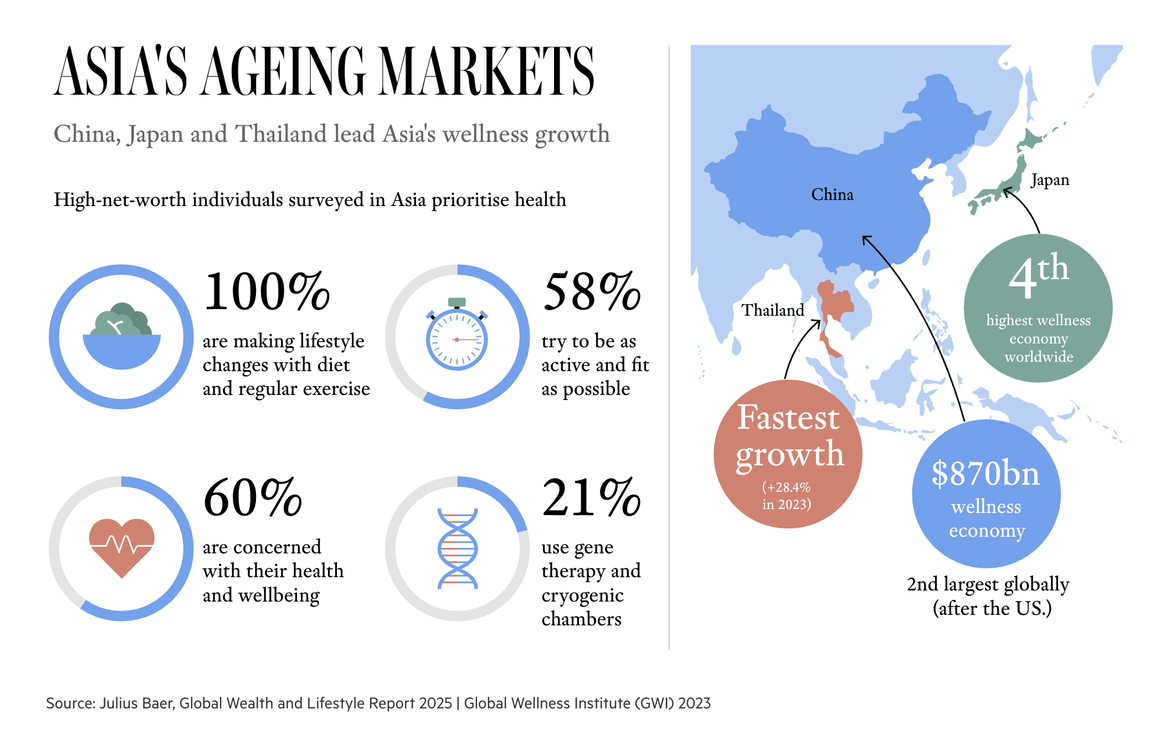
Geographically, the fastest expansion is taking place across Asia. China commands an $870 billion wellness economy (second only to the United States), Japan holds the 4th spot globally, and Thailand recorded a single-year growth surge of 28.4% in 2023.
“The ‘longevity economy’ – affluent, health-conscious individuals seeking to extend their healthy years – is driving growth across continents.” — Simone Gibertoni, CEO of Clinique La Prairie
3. Financial Directives: Adjusting Capital Strategy for a 100-Year Horizon
Living longer fundamentally alters capital allocation, wealth transfer, and liquidity planning. According to Julius Baer’s Global Wealth and Lifestyle Report 2025, ultra-high-net-worth individuals—particularly in the Asia-Pacific region—are making personal and family well-being their primary operational focus.
“The biggest risk to a wealthy family is not that the money runs out. It is that the person outlives the plan built for them. There is a quiet assumption buried inside most wealth plans. It assumes people die roughly on schedule. They do not. In Bank of America’s 2026 Study of Wealthy Americans, 92 percent of respondents named longevity as a key factor in their planning. And there is good reason. A man who has already reached 65 today has a one in four chance of living to 92, according to the Stanford Center on Longevity. For a healthy, well resourced couple with access to the best medicine on earth, planning to live into the mid 90s is no longer conservative. It is realistic. JP Morgan’s private bank now forecasts its clients’ wealth using life expectancies in the early 90s as a baseline.” — Ryan Faridian, Global Solutions Family Office
For business owners, family offices, and investors, longevity demands action on three distinct fronts:
- Portfolio Restructuring: Investors must systematically re-evaluate retirement targets, existing trust structures, and asset allocation to accommodate extended life horizons.
- Growth Capital in Medtech & Biotech: Capital is flowing into artificial intelligence drug discovery, preventative treatments, gene therapies, and specialized medtech solutions—such as advanced lens implants for presbyopia (age-related vision loss).
- Physical Asset Opportunities: Luxury medical hospitality and real estate infrastructure are scaling rapidly to meet demand. Operators like Clinique La Prairie are building international resorts in Anji (China), Amaala (Saudi Arabia), and Phuket, while deploying urban “Longevity Hubs” in cities like Bangkok and Taipei.
“The majority of HNWIs would adjust their wealth strategy to cover an increase in lifespan, with measures ranging from reviewing their existing wealth structure and rebalancing their portfolios to re-evaluating retirement goals.” — Dr. Damien Ng, Next Generation Research Analyst at Julius Baer
4. Personal Action Plan: High-Tech Diagnostics Meets Fundamental Discipline
At an individual level, maximizing health span requires combining advanced clinical diagnostics with rigorous personal routines. High-end longevity clinics map biological aging markers using a multi-layered diagnostic suite:
- Comprehensive Biomarkers: Deep blood panels, advanced diagnostic imaging, genetic sequencing, epigenetics, and metabolomics.
- Targeted Clinical Interventions: Cellular ageing therapies, precision medications, and custom nutraceutical protocols designed to reduce systemic inflammation and cellular oxidative stress.
- Lifestyle Optimization: Scientific measurement and fine-tuning of sleep, nutrition, and physical conditioning.
However, high-tech treatments alone are insufficient. Fundamental daily practices—regular exercise, outdoor movement like hiking or jogging, proper sleep, and personal discipline—remain the indispensable foundation of biological longevity.
“Beyond money, longevity is about well-being, fulfilment and purpose in life. In other words, we should see a fundamental shift from material goods to experiences, and from quantity to quality.” — Dr. Damien Ng, Next Generation Research Analyst at Julius Baer