The history of a legendary American family: how they built and lavished their fortune
Amorim — When Wine Breathes with Love
Behind every good wine stands a quality cork. With these words, the Portuguese corporation Amorim Group welcomes visitors to its website. When you get to know the company better, you realize that it’s not just empty rhetoric. The Amorim family entered the business back in 1870. Over the course of 150 years, a small winery producing cork stoppers has transformed into a global industry leader. Today, Amorim Group controls 65% of the world’s natural cork market. Throughout this time, four generations have passed in leadership, yet the values remain steadfast: caring for nature and consumer comfort.
Corks are crafted from the bark of cork oak trees. The bark can only be harvested once the tree reaches 20-25 years of age. The following 10 years are dedicated to regeneration. The best-quality bark comes from a 150-year-old oak, yielding 1000 corks per tree at a time. So, the next time you discard a wine cork, it’s worth contemplating. It’s certainly worthy – if not for becoming a decorative element, then for repurposing. It could turn into things like a surfboard or a Birkenstock sole. By the way, the company itself recycles raw material leftovers, producing floors and other construction materials. But let’s return to the market.
Natural cork holds 70% of the global market share, leaving screw caps and synthetic alternatives far behind. Today, natural corks seal around 13 billion wine bottles out of a total of 20.5 billion produced annually. Amorim sells over 6 billion corks per year.
Since the beginning of our century, the company has invested over 50 million euros in research and innovation, successfully overcoming the issue of TCA contamination that affects the taste of wine. To explain simply: the cork reacts with the wine, causing the product to acquire a wet cardboard smell. Thanks to the innovative ROSA system, the risk of wine being affected by TCA has dropped from 7% to less than 1%.
Amorim went public in 1988. In 2022, for the first time in the company’s history, sales exceeded 1 billion euros. In the first six months of this year, cork sales alone increased by 5.4% (almost 424 million euros).
Cork is a renewable, zero-waste, and recyclable natural material. Cork oak forests lead in terms of biological diversity in the Mediterranean, preventing desertification, they “breathe.” However, if cork oak stops justifying its existence economically, sadly, there might be little to save it. There was a time when, due to economic reasons, cork forests in the Algarve region in southern Portugal decreased by 28%. Every time we choose wine with a natural cork, we’re choosing the health of the planet.
The Remarkable Journey of Nadia Nadim: From Refugee to Football Star
The Early Years: An Unsettled Childhood
As the sun rose over the city of Herat, Afghanistan, a young girl named Nadia Nadim was born into a world of unpredictability and strife. The year was 1988, and this was a time when Afghanistan was fraught with warfare, leaving little room for dreams, especially for a girl. Yet, Nadia was destined to shatter these norms.
She was the youngest of five girls in a family that prized education and sports. Her father, an Afghan National Army general, was a firm believer in the power of education and believed that his daughters should have every opportunity to learn and grow. But the political climate of the country was not favorable for these ideals. The rise of the Taliban regime brought an end to the dreams of many, including the Nadim family.
The unthinkable happened when Nadia was just ten years old. Her father was summoned to a meeting with the Taliban and never returned. Presumed to be murdered, his absence left a gaping hole in the family. In the midst of this despair, Nadia’s mother bravely decided to escape the oppressive regime with her five daughters. A perilous journey across borders awaited them, but the dream of a better life fueled their courage.
A New Home: Embracing the Unknown
The family made their way to Europe, initially landing in Italy. From there, they were smuggled in the back of a truck with the promise of reaching England. However, the journey ended in Denmark. While it wasn’t their intended destination, Denmark offered them something they hadn’t had in a long time – safety and the freedom to dream.
Life in a refugee center was challenging, but it also offered Nadia an unexpected gift – football. Watching boys play in a nearby field, Nadia was instantly attracted to the game. She convinced her mother to let her play, and with that, a spark was ignited. Football became her refuge, a means to navigate her new life. The game brought her joy and a sense of belonging in an otherwise unfamiliar land.
Although she didn’t know it then, football was not just a hobby for Nadia; it was her calling. She joined a local club, Gug Boldklub, where her talent was quickly recognized. From there, she swiftly climbed the ranks of Danish football, joining top-tier clubs and eventually making it to the national team. Nadia was making her mark in a big way, and she was just getting started.
Finding Success: The Rise of a Champion
In 2009, Nadia made her professional debut with the Danish Women’s National Team. Her natural ability to score goals, combined with her tenacious spirit, made her a standout player. Nadia was not just playing football; she was changing the narrative for female athletes, particularly those of immigrant backgrounds.
Her talent caught the attention of international clubs, and in 2014, Nadia signed with Sky Blue FC, marking her entry into the prestigious National Women’s Soccer League (NWSL) in the United States. She continued to impress, earning a spot with Portland Thorns FC, where she helped lead the team to an NWSL Championship in 2017.
In 2018, Nadia’s journey took another exciting turn when she signed with Paris Saint-Germain, one of the world’s most renowned football clubs. Here, she continued to shine, both on and off the pitch.
Beyond her footballing prowess, Nadia became a symbol of determination and resilience. Throughout her career, Nadia has been a vocal advocate for women’s rights and equality in football. She uses her platform to shed light on the issues that matter, challenging the status quo and pushing for change. “I hope to inspire others to believe in themselves and to fight for their dreams,” Nadia once said. A quote that perfectly captures her spirit and determination.
Facts and numbers
$26000 Nadia Nadim earns weekly at Racing Louisville, according to reports
11 languages Nadia speaks as a multi lingual: English, French, German, Dari, Farsi, Urdu, Swedish, Norwegian Parsian, Arabic and Hindi.
Looking Ahead: Nadia’s Future Plans
After achieving so much in her football career, one might wonder what’s next for Nadia Nadim. Well, she’s not one to rest on her laurels. In 2022, Nadim fulfilled her goal of becoming a doctor, specifically in reconstructive surgery. She attended medical school at Aarhus University remotely during the football season.
When she began playing football in Denmark, coaches at her first club offered to cover transport expenses given how far away she lived from it at the time.
These moments “had a huge impact on me,” said Nadim. “I know as a doctor, I’ll be able to do that for other people”. “I know the value of helping a person when they have no hope,” she told The Guardian. “I know 100 percent that I want to be a surgeon.”
In early 2022, the dream that she had been working towards for all these years came true as she qualified to become a doctor. Nadim shared the news across her social media, saying: “For the haters, I did it again. Kicked a** and there’s nothing you can do about it!”
Lessons from Nadia Nadim’s Journey
Nadia’s life story is a testament to the power of dreams and the indomitable human spirit. Despite the numerous challenges she faced, from losing her father to navigating life as a refugee, she never let her circumstances define her. Instead, she dared to dream big, using her passion for football as a vehicle to change her life.
Nadia’s journey also highlights the importance of perseverance. Success didn’t come easily. She faced numerous setbacks and obstacles, but she never gave up. She worked hard, practiced relentlessly, and never lost sight of her goals. This resilience is a powerful reminder that success often lies beyond the challenges that seem insurmountable at the time.
Perhaps the most important lesson from Nadia’s story is her spirit of service. She used her success not just to benefit herself, but to inspire and uplift others. She became a role model for young girls and refugees, using her platform to advocate for change. This spirit of service is a reminder that success is not just about achieving our personal goals, but also about making a positive impact on the world around us.
In the end, the story of Nadia Nadim is one of courage, resilience, and determination. It’s a story that reminds us that no matter where we come from or what challenges we face, we all have the power to shape our own destiny.
The number one New York Times bestselling authors of Vanderbilt return with another riveting history of a legendary American family, the Astors, and how they built and lavished their fortune.
The story of the Astors is a quintessentially American story—of ambition, invention, destruction, and reinvention.
From 1783, when German immigrant John Jacob Astor first arrived in the United States, until 2009, when Brooke Astor’s son, Anthony Marshall, was convicted of defrauding his elderly mother, the Astor name occupied a unique place in American society.
The family fortune, first made by a beaver trapping business that grew into an empire, was then amplified by holdings in Manhattan real estate. Over the ensuing generations, Astors ruled Gilded Age New York society and inserted themselves into political and cultural life, but also suffered the most famous loss on the Titanic, one of many shocking and unexpected twists in the family’s story.
In this unconventional, page-turning historical biography, featuring black-and-white and color photographs, #1 New York Times bestselling authors Anderson Cooper and Katherine Howe chronicle the lives of the Astors and explore what the Astor name has come to mean in America—offering a window onto the making of America itself.
A masterful, timely, fully authorized biography of the great and hugely influential biologist and naturalist E. O. Wilson, one of the most ground-breaking and controversial scientists of our time—from the Pulitzer Prize-winning author of The Making of the Atomic Bomb
“An impressive account of one of the 20th century’s most prominent biologists, for whom the natural world is ‘a sanctuary and a realm of boundless adventure; the fewer the people in it, the better.’” —The New York Times Book Review
Few biologists in the long history of that science have been as productive, as ground-breaking and as controversial as the Alabama-born Edward Osborne Wilson. At 91 years of age he may be the most eminent American scientist in any field.
Fascinated from an early age by the natural world in general and ants in particular, his field work on them and on all social insects has vastly expanded our knowledge of their many species and fascinating ways of being. This work led to his 1975 book Sociobiology, which created an intellectual firestorm from his contention that all animal behavior, including that of humans, is governed by the laws of evolution and genetics. Subsequently Wilson has become a leading voice on the crucial importance to all life of biodiversity and has worked tirelessly to synthesize the fields of science and the humanities in a fruitful way.
Richard Rhodes is himself a towering figure in the field of science writing and he has had complete and unfettered access to Wilson, his associates, and his papers in writing this book. The result is one of the most accomplished and anticipated and urgently needed scientific biographies in years.
Chronicling 200 years of glamour, hedonism and crime, this rich and vivid history of the French Riviera features a vast cast of famous characters.
A Financial Times ‘Book to Read in 2023’
In 1835, Lord Brougham founded Cannes, introducing bathing and the manicured lawn to the wilds of the Mediterranean coast. Today, much of that shore has become a concrete mass from which escape is an exclusive dream. In the intervening years, the stretch of seaboard from the red mountains of the Esterel to the Italian border hosted a cultural phenomenon well in excess of its tiny size.
A mere handful of towns and resorts created by foreign visitors – notably English, Russian and American – attracted the talented, rich and famous as well as those who wanted to be. For nearly two centuries of creativity, luxury, excess, scandal, war and corruption, the dark and sparkling world of the Riviera was a temptation for everybody who was anybody. Often frivolous, it was also a potent cultural matrix that inspired the likes of Picasso, Matisse, Coco Chanel, Scott Fitzgerald, Cole Porter, James Baldwin, Catherine Mansfield, the Rolling Stones, Sartre and Stravinsky.
In Once Upon a Time World, Jonathan Miles presents the remarkable story of the small strip of French coast that lured the world to its shores. It is a wild and unforgettable tale that follows the Riviera’s transformation from paradise and wilderness to a pollution imperilled concrete jungle.
Discover the official story of In-N-Out Burger––how three generations have created a thriving, family-owned company, why its fans are so wildly loyal, and what led to its explosive growth and evolution into an iconic part of American culture––as told by In-N-Out Burger’s president, Lynsi Snyder.
When Lynsi Snyder’s grandparents founded In-N-Out Burger in 1948, they built it with a passion for quality and service that Lynsi embraced at a young age. After starting as a store associate at age seventeen, she then worked in other departments, gaining first-hand experience with almost every aspect of the family business until she became president in 2010. She has led the company through explosive growth––today, there are three-hundred and eighty stores and counting––and is deeply committed to the well-being of the In-N-Out Burger family.
In The Ins and Outs of In-N-Out, you’ll:
Gain key insights into why In-N-Out has maintained its very popular and limited menu for more than seventy-five-years and why it has refused to franchise or go public
Hear behind-the-scenes stories from In-N-Out Associates, including from one gentleman who worked in the very first store
Learn about the Snyder family’s Christian faith, including her grandmother Esther’s belief in the gospel and her uncle’s “born-again” experience that shaped his life and leadership at the company
Discover why Lynsi has been ranked as one of the top presidents in the restaurant industry and how her personal challenges have fortified her faith and shaped her dedication to servant leadership
In-N-Out Burger has drawn fiercely loyal fans––from professional chefs and burger aficionados to celebrities and scores of everyday customers––who not only crave the burgers, fries, and milkshakes but also come back again and again for the community.
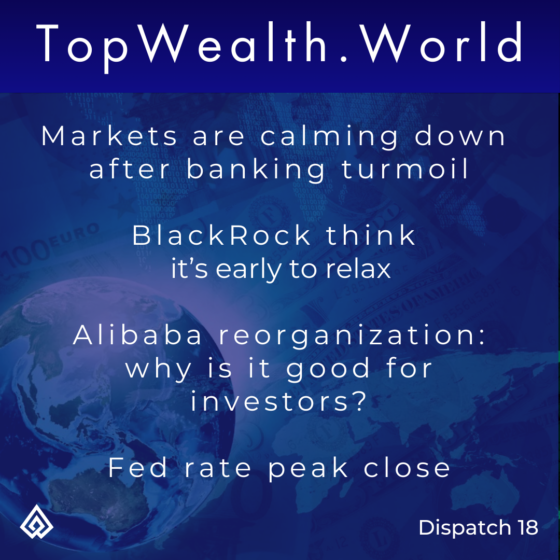
Breaking news: markets are calming down after banking turmoil as BlackRock think it’s early to relax.
Alibaba reorganization: why is it good for investors?
Fed rate peak close
Breaking news: markets are calming down after banking turmoil as BlackRock think it’s early to relax
▪️ US stocks mostly up on Monday
The S&P 500 gained 0.2%, the Dow Jones 0.6% and the high-tech Nasdaq shed 0.5%. Investors’ fears about the banking sector continue to decline. This is because regulators offer various measures to support the industry. Against this background, even the index of regional banks in America – S & P Regional Banks – rose yesterday by 0.9%.
▪️ Asia-Pacific stocks predominantly up
Asia’s broadest index (excluding Japan) MSCI AC Asia ex Japan Index rose about 0.5% today, South Korea’s Kospi added 0.6%, Singapore’s STI rose 0.4%, Hong Kong’s Hang Seng and China’s Shanghai Composite rose by 0.7% and 0.1% respectively, while the Japanese Nikkei remained virtually unchanged. All – due to the decrease in investors’ fears about the recent turmoil in the banking sector.
▪️ BlackRock: Markets are wrong about US rate cuts
The world’s largest asset manager predicts that the Federal Reserve will continue to raise interest rates. This, according to experts, will happen, even though investors, amid fears of a banking crisis, expect the opposite. BlackRock predicts a phase of slightly softer containment of inflation, but still no interest rate cuts this year. Realize market expectations, according to BlackRock, the Fed will only be able to if there is a more serious banking crisis, which is likely to cause a deep recession.
▪️ Shares of energy companies rise in price against the backdrop of rising oil prices
The industry index – S&P 500 Energy – rose 2.1% yesterday. Growth leaders include Schlumberger (+5%), Hess (+3.6%), Targa Resources (+3.5%), Marathon Petroleum (+3.4%) and Devon Energy (+3.2%). U.S. energy stocks traded higher on Monday as oil prices continued to rise. This was facilitated by the weakening of concerns about the banking crisis, as well as the reduction in oil exports from Iraq. As a result of yesterday’s trading, Brent futures rose 4.1% to $78.12 per barrel, while WTI contracts added 5.1% to $72.81.
▪️ Private equity deals in Asia fell 44% in 2022
In 2022, the total value of transactions in the private equity market in Asia fell to $198 billion, compared with $354 billion a year earlier, according to Bain & Company. The authors of the study attributed the decline in direct investment to a decrease in investors’ willingness to take risks against the backdrop of high inflation and geopolitical tensions. Continued macroeconomic uncertainty, along with rising costs and deteriorating financial performance of companies, will continue to weigh on investors in Asia well into 2023, according to Bain & Company.
Alibaba reorganization: why is it good for investors?
Alibaba shares are up 10% today on news that the world’s largest e-commerce player will split into 6 separate companies.
❓Why this decision was made
This announcement was preceded by the return of head Jack Ma to China. Recall that he disappeared from the public field and was shown only abroad (outside of China) after the Chinese authorities banned the IPO of his fintech ANT Group in 2020. The authorities were unhappy with the fact that large IT corporations have too wide access to the personal data of the population and create the risks of a monopoly in consumer markets. Jack Ma most likely decided to solve this problem, so he came to China, and Alibaba announced the division of business.
❓How the holding will be divided
We have indicated the reorganization process in the table. The public structure of Alibaba Group itself will continue to own the largest asset – Taobao Tmall Commerce Group (this includes Taobao and Tmall marketplaces). It operates in China and generates the main operating income of the holding.
The remaining 5 companies will be private, which may go on IPO in the future. Now is not the best time to enter the primary market. The only one of the 5 segments that consistently earns operating income is the cloud segment. The rest are unprofitable. However, the logistics division and the international e-commerce segment may soon become profitable, since the holding previously distributed a lot of losses to these structures, and now they will become independent. Therefore, in the future they may be attractive for investment.
❓What’s good for Alibaba and its shares
Separation of assets significantly reduces the risk of regulatory interference from the Chinese authorities. He has hung over Alibaba for the past few years and continues to threaten other major Chinese corporations. The arrival of Jack Ma is most likely connected precisely with negotiations with Chinese regulators and other large investors in Alibaba. So far, there are no legal details about the unbundling deal, but the reduction of regulatory risk will have a positive impact on the holding’s shares.
It should be noted that regulators express claims to large corporations not only in China, but also in the US and the EU. Alibaba could become the biggest asset-sharing example of the 21st century, and the practice could be followed by corporations in other countries, including the US. Therefore, the news of Alibaba’s asset split is generally positive for global equity markets.
We confirm our trade idea to buy Alibaba stock and maintain our 12-month target of 120 HKD/share. Growth potential – 29%.
Fed rate peak close
On March 22, the Fed raised the key rate by 25 bp. (up to 4.75-5%). This decision of the regulator was prompted by persistent inflationary risks. At the same time, Fed Chairman Jerome Powell said that the option of keeping the rate unchanged was also considered (against the background of the recent collapse of two American banks). He also hinted that the current promotion could be the last. Meanwhile, the reduction in the Fed’s balance sheet (quantitative tightening, QT) will continue.
❓What the regulator said about banks
The regulator reassured that the US banking system is resilient and recent events are likely to tighten credit conditions for households and businesses. This will put pressure on economic activity, hiring and inflation, which is, in essence, the equivalent of a rate hike.
❓What forecasts does the regulator give
The Fed kept the median rate forecast for 2023 at 5.1% and raised its forecast for 2024 from 4.1% to 4.3%. Expectations for 2025 have not changed – 3.1%. Thus, the regulator is planning another increase of 25 bp. and is not going to cut the rate until the end of this year.
The Fed also lowered its GDP forecast for the current year from +0.5% to +0.4% y / y, while lowering expectations for the unemployment rate from 4.6% to 4.5%. Inflation at the end of 2023 is expected at 3.3% (December forecast: 3.1%), and core inflation at 3.6% (December forecast: 3.5%).
❓How did the markets react
After the meeting, the yield on ten-year US Treasury bonds fell by 0.106 percentage points, dropping to 3.497%. The S&P 500 fell 1.6% and gold rose 1.5% to $1,970 an ounce. We still expect the growth of gold quotes as more and more regulators will be forced to move on to easing monetary policy. This year we can see gold at the level of about $2020-2040 per ounce.
❓What will happen next
The moment has come when the Fed has to simultaneously fight inflation and financial instability, which was partly caused by tightening policy. As recently as a few weeks ago, Jerome Paeull argued strongly that a rate hike above 5.25% might be needed, as economic data pointed to an acceleration in economic growth with persistently high core inflation. However, problems in the banking system have changed the situation. Now the regulator is waiting for the rate to peak at 5.25%. In turn, the market believes that the Fed rate has already reached its peak and there will be no more increases. Moreover, investors are waiting for the first rate cut at the meeting at the end of July.
We believe that the regulator will be able to quickly cope with the difficulties that have arisen in the banking system and the Fed will still bring the rate to 5.25% at the upcoming meeting in May. At the same time, we expect the regulator to start lowering the rate in the second half of 2023. So far, everything is in line with our December market forecasts for 2023.
One should fall in love with ideas, with people, or with idealism based on the possibilities that exist in this adventuresome world. The last thing to fall in love with is a particular security. It is, after all, just a sheet of paper indicating a part ownership in a corporation. Its use is purely mercenary. I learned early in my career to be skeptical and flexible, not stubborn, about a stock. I also learned to take quick, small losses rather than to get emotionally involved in a stock that was dragging me down. Some people have been extremely fortunate in the past by falling in love with something that went their way. That is not necessarily proof it will always be that way. In other words, it’s alright to be in love with a security- until it gets overvalued. Then let somebody else fall in love.
Topics of the week
What first led me to Wall Street was a desire to make money so I could buy great art and support artists. What I didn’t know when I started is that working on Wall Street can be a fascinating art in itself and one for which I was almost immediately suited.
— Roy Neuberger
Frederik Gieschen talks about So Far, So Good — The First 94 Years, the autobiography of Roy Neuberger (co-founder of asset manager Neuberger Berman). Neuberger wrote the book in 1997, at 94 years old, while he was still working. He’d arrived on Wall Street on the eve of the crash in 1929 and was one of very few people to experience the market’s full arc from 1929 to 2008. He passed away in 2010, at age 107.
Frederik Gieschen:
Honestly, more than investment advice I was hoping for his formula for longevity. Aside from genes, what jumped out at me was his daily exercise, doing work he enjoyed, a passion that led to a rich social life, a lasting marriage, an emphasis on family, and a daily morning walk with friends.
The book is an autobiography and not an investment how-to manual. It features Neuberger’s passion for art just as prominently as his interest in the market. That said, it contains some enduring ideas about markets and life. And it’s worth pondering what someone with 68 years of experience in markets considers important: Neuberger wanted to pass on a collection of core principles, not formulas. He wanted to teach us how to think, not what specifically to do.
Neuberger came from a wealthy family and lost both his parents at a young age. He spent some time working at a department store and traveled to Europe where he discovered his love for art. He was enrolled at NYU but dropped out to work without ever getting a degree.
The book illustrates how different Wall Street was at the time. Neuberger showed up at a brokerage firm and immediately got a job as a runner delivering trade orders. He climbed the ranks and became a broker. He also had a head start by managing the accounts of wealthy relatives. Neuberger was very successful (Neuberger Berman today manages some $460bn) but it’s not a rags to riches story.
“I chose Wall Street because in the 1920s, that’s where the money was.”
Neuberger was devoted to the game of markets but he placed his work in service of his true love: art.
Some people waste their lives in the constant pursuit of great wealth. As a commodity, let’s face it, money doesn’t rate as high as good health and it certainly isn’t up there with great art.
Money in and of itself has never really interested me. The driving passions of my career and my life have been the art of trading and the support of art. Money, of course, has been the by-product of trading that enabled me to purchase great art and support culture.
After reading a biography of van Gogh, who struggled to make a living during his lifetime, Neuberger dedicated himself to collecting the work of living artists. He never sold but rather donated countless works over the course of his life.
Neuberger was always clear about the higher purpose of his work on Wall Street. Accumulating wealth was never an end in itself.
I wanted to be able to buy the works of living artists, to support their work financially. … In February 1929, after returning to Paris from Berlin and Vienna, I began to make arrangements to come home to New York, determined to enter an arena about which I knew absolutely nothing: Wall Street.
Everyone knows the reply by the celebrated safecracker Willie Sutton to the question: Why do you rob banks? “Because,” he said, “that’s where the money is.” I chose Wall Street because in the 1920s, that’s where the money was.
1929 and Radio Corporation of America
It’s funny how our first experiences with the market can shape our entire careers. Neuberger arrived on the street in 1929, during the final mad days of the bubble. One of his first big trades was to short the market darling, Radio Corporation of America or RCA. The stock was already weakening, as was the entire market, and the valuation made no sense to him.
The most actively traded stock on Wall Street at that time was Radio Corporation of America referred to as “Radio”), which evolved into RCA as we know it to-day. I studied that company more than any other. I really learned the ins and outs on a lot of different levels.
Radio Corporation of America reached a high of 574. Then it split 5 for 1. I set out to discover why the stock was so high and so active. Nothing seemed to justify the seemingly excessive price. I asked older, more experienced investors, but I received no definitive answers. People explained that we were entering the radio age-simple as that.
Neuberger shorted RCA stock worth 100% of his portfolio. It’s hard to overstate how lucky he got here. Others had shorted Radio during the bull market and been steamrolled. When the market crashed, RCA collapsed and protected Neuberger’s portfolio while those around him lost their fortunes.
This moment defined his career: Neuberger always considered himself a trader and kept hedging to protect himself — though he explicitly did not recommend shorting to his readers because one needs “a stubborn, perverse, and patient temperament.”
In many ways, the Panic shaped my current approach to the market: I am prematurely bearish when the market experiences a prolonged ascent, when everybody is pleased because they’re growing richer.
Margin leverage had been a key driver inflating the bubble and when investors around Neuberger refused to protect themselves, they could lose everything in the collapse. Neuberger drew his own conclusions:
In order to do well, you must be able to learn from the past. And you need to look at things objectively. I learned to be absolutely pragmatic and realistic during the prolonged bear market that ensued after the Panic.
I think one of the biggest problems of the 1920s was the systematic refusal by so many people to be realists. They wanted the boom to continue forever, so they failed to notice how much of it was fleeting.
Many businesses appeared to be in better shape than they actually were. Examples of failure were everywhere: The textile industry suffered a huge crash in 1924; Florida was the site of a major real estate panic in 1925 and did not recover for many years. But people refused to see the warning signs.
Simply surviving and persisting in the business proved important as well. As brokers around him left the business, Neuberger picked up their accounts.
Trader or investor?
Neuberger also reminded me of Irving Kahn, another survivor of the crash and Wall Street old-timer, who lived to be 109. They even graduated from the same high school. While Kahn was a Graham and Dodd value disciple, his style was eclectic.
“It’s impossible to reverse-engineer Irving’s investment process,” says Carl Schecter, the head of risk-arbitrage trading at Nomura Securities in New York and a long-time Kahn Brothers client. “It’s an idiosyncratic mix of top-down economic insight and bottom-up financial analysis.”
The same seems true of Neuberger who doesn’t quite fit one mold. On the one hand, he had a trader’s mindset. With his art he was happy to buy and hold forever. By contrast, “getting married to a stock can prove disastrous.”
He compared his trading style to his “youthful addiction to tennis.” You had to do your homework and be prepared to act with speed when the market presented opportunities.
You have to make fast decisions. You can’t wait to think about it overnight.
On the other hand, Neuberger discussed the importance of finding great companies that could do well over long periods of time. Unfortunately, he doesn’t offer much specific advice.
The criteria for purchase of any substantial amount of stock should remain on solid grounds that stand the test of time: (1) a good product; (2) a necessary product; (3) honest, effective management; and (4) honest reporting.
True, but not particularly helpful. Neuberger called missing Coca-Cola his ‘biggest mistake’.
Then came the biggest mistake I’ve ever made on Wall Street–a lost opportunity. I misdiagnosed the potential of a great corporation-Coca-Cola because I knew it had stiff competition from Pepsi and other soft drinks. I simply didn’t take seriously the proposition that this was a great growth company like AT&T. I am pointing out humbly that it is impossible to be right all the time on Wall Street. My perspectives on the potential of Coca-Cola were misguided, and I never should have sold it.
But he doesn’t elaborate on his analysis of Coca-Cola or other companies and business models. And holding a great company to let it compound is not consistent with one of his other principles, the stop-loss or “10%” rule:
You can’t always win on Wall Street, so you have to learn to cut losses quickly and move on gracefully. At one point, I was bullish on International Harvester.
Right after I bought it, unfortunately, it began going down, down, down and I realized I had made a mistake. I sold it the same day, lucky to take a small, quick drop rather than a big, drawn-out loss.
Getting married to a stock can prove disastrous. The 10 percent rule is sensible: If your stock starts falling, take a loss of 10 percent and start again. I take this idea very seriously, and it’s worked quite well for me. The flip side of that rule is not to be greedy with profits. Never try to guess the top.
He may have picked up this 10% stop loss rule from Gerald Loeb’s The Battle for Investment Survival, a popular post-crash trading book. “I’m inclined to say that when a new investment has shrunk by 10%, it is time to stop, look and listen,” Loeb wrote. Buy and hold seemed dead in the painful bear market that followed 1929.
My sense was that Neuberger, like other market veterans, operated with multiple mental models. He could hold a compounder like AT&T for the long run but also be a nimble trader in many other securities.
He used the stop-loss rule to protect himself from behavioral biases. Neuberger had observed too many smart people in denial in 1929. The stop-loss was a way to protect himself from that fate.
Remember how Richard Whitney watched his stocks decline in 1929 until he was wiped out? He failed to follow the 10 percent rule: If the stock is on the way down, take your loss at the 10 percent level. This rule has helped me many times. Using the money elsewhere will usually be more fruitful than maintaining a mistaken position.
One of the enduring lessons of Neuberger’s life is that nobody is bigger than the market. Ego can be absolutely deadly.
I received a real education into seeing things as they are, not as one might wish they were. I learned that the market has a rhythm of its own, like the waves of the ocean. Every few months, there is a change. Sometimes a long-term investor can ride out the ups and downs. But I’m a trader. I have to be closely attuned to the changing waves. It’s often a choppy voyage.
What we can learn from someone who survived in markets for 68 years is to be flexible, to adapt, to not let ourselves get emotional.
One should fall in love with ideas, with people, or with idealism based on the possibilities that exist in this adventuresome world. The last thing to fall in love with is a particular security. It is, after all, just a sheet of paper indicating a part ownership in a corporation. Its use is purely mercenary.
I learned early in my career to be skeptical and flexible, not stubborn, about a stock. I also learned to take quick, small losses rather than to get emotionally involved in a stock that was dragging me down.
Some people have been extremely fortunate in the past by falling in love with something that went their way. That is not necessarily proof it will always be that way. In other words, it’s alright to be in love with a security- until it gets overvalued. Then let somebody else fall in love.
A work of art
Neuberger started one of the first “no-load” mutual funds (no upfront sales commission), a novel idea at the time. Just like he was early in his focus on contemporary artists, Neuberger liked the idea of breaking with convention:
As an idealist, I don’t generally like to accept what is called conventional wisdom. I had great respect for my elders, but I learned early that everything practiced by my contemporaries was not necessarily sound.
Unsurprisingly, he considered the fund his enduring contribution to the world (like Buffett with Berkshire as his canvas).
The book is not a must-read for investors but I enjoyed it, mainly because of Neuberger’s passion, character, and the sheer magnitude of perspective and life experience he brought to the table. Its enduring message is that to master the market, you must master yourself. And if your autobiography is about a lot more than markets, that’s an indication of a rich life.
Neuberger himself pointed out not to copy what worked for him on Wall Street, that “wonderful, exciting game.” “If you do, you will go crazy,” he warns. “You have to dig for yourself, just as I do.”
It is invigorating for me to use my brain to analyze what is going on. If I have taught you how to use your brain in a different way, then I will have fulfilled the first mission of a teacher — to make oneself expendable. And you will have learned the most important lesson — how to learn.
The Making of the Modern Philippines: Pieces of a Jigsaw State
by Phillip Bowring
With a fractured geography and complex identity, The Philippines is an eclectic and unique mix of culture, environment, people and politics. Known mostly for natural disasters, migrant labour and dictatorial presidents, in this book Philip Bowing shows how it is much, much more. Deftly navigating the history of this populous island republic, The Making of the Modern Philippines traces its history to define and explain its position in the modern world. Looking past the headlines of volcanoes, earthquakes and violence, it asks why has the Filipino economy lagged behind its neighbours, explores the importance of its location in geopolitics, and investigates how its deep-rooted Catholicism clashes with the Islamic consciousness of the region in which it sits. Taking the history of the Philippines from its pre-colonial era, through its Spanish and American occupations and up to the modern day, it unravels the complex politics, culture, peoples and economy of this rich and unique nation. Engaging with challenges the Filipino people face today such as federalism, revolution, Mindanao, the diaspora, capitalism and relations with China, it rediscovers the struggles, culture and history of its past to understand the present.
“Eat local” has become a popular marketing slogan in recent years, based on the idea that food grown or raised nearby is better for you and friendlier to the environment than similar products shipped in from many miles away. That slogan reflects a broader worldview suggesting that everything local, including government and knowledge, is better than what originates somewhere else. Small Isn’t Beautiful acknowledges that some things that are local are good, but denies that what’s local is always or even often better than what’s far away. “Localism” is based on an “undeserved aura of respectability, virtue, and good sense” and can produce results that are misguided or even dangerous. Particularly when it comes to public policies, decisions made at the local level are rarely superior and are sometimes unjust. Small Isn’t Beautiful exposes the supposed “virtue” of localism as a hodgepodge of weak arguments and misleading hunches. Trevor Latimer’s engagingly written and provocative book will appeal to all readers who want to understand localism beyond slogans and marketing.
How Big Things Get Done: The Surprising Factors That Determine the Fate of Every Project, from Home Renovations to Space Exploration and Everything In Between
by Bent Flyvbjerg, Dan Gardner
Nothing is more inspiring than a big vision that becomes a triumphant, new reality. Think of how the Empire State Building went from a sketch to the jewel of New York’s skyline in twenty-one months, or how Apple’s iPod went from a project with a single employee to a product launch in eleven months. These are wonderful stories. But most of the time big visions turn into nightmares. Remember Boston’s “Big Dig”? Almost every sizeable city in the world has such a fiasco in its backyard. In fact, no less than 92% of megaprojects come in over budget or over schedule, or both. The cost of California’s high-speed rail project soared from $33 billion to $100 billon—and won’t even go where promised. More modest endeavors, whether launching a small business, organizing a conference, or just finishing a work project on time, also commonly fail. Why? Understanding what distinguishes the triumphs from the failures has been the life’s work of Oxford professor Bent Flyvbjerg, dubbed “the world’s leading megaproject expert.” In How Big Things Get Done, he identifies the errors in judgment and decision-making that lead projects, both big and small, to fail, and the research-based principles that will make you succeed with yours.
Many individuals are curious about where millionaires keep their wealth, and for good reason. By gaining insight into the financial habits of the wealthy, we can learn from their success and potentially improve our own financial situation. The data shows that millionaire households allocate approximately 25% of their wealth to their primary residence and 15% to business interests, with the remaining 60% invested in stocks, bonds, and cash. However, as households become even wealthier, the proportion invested in stocks, bonds, and cash tends to decrease, with business interests becoming the dominant source of wealth.
Topics of the week
Where Do Millionaires Keep Their Money?
Nick Maggiulli, Chief Operating Officer for Ritholtz Wealth Management LLC., published a great post.
If you’ve ever wondered, “Where do millionaires keep their money?” then you’re not alone. Many people are curious about the financial habits of the wealthy, and for good reason. Having a better understanding of how millionaires manage their money can help us learn from their successes and potentially improve our own financial well-being as well. We’ve touched on this before in one of the previous Dispatches. In his blog post, Nick dives deeper and explores the various options available to millionaires for storing and growing their wealth. From traditional asset classes to more exotic investments, we’ll take a closer look at the strategies millionaires employ to protect and grow their fortunes. Whether you’re a millionaire looking for new ways to manage your money or just someone who wants to learn from the best, this post has something for you. Here we go.
How Do Millionaires Invest Their Money?
To figure out how millionaires invest their money, I will be examining the three primary investment decisions that impact their returns (according to the late pioneer of institutional asset management David Swensen):
Asset allocation: What asset classes do millionaires invest in.
Market timing: When do millionaires buy/sell those assets.
Security selection: How do millionaires choose which securities to buy within an asset class.
To do this, I will primarily be relying on Vanguard’s 2020 How America Invests study, which examines how affluent households (those with at least $500,000 in investable assets at Vanguard) invest their money. While not all of the households in this study are millionaires, the vast majority of them are. The median household in the study has over $1 million with Vanguard and those below the median have assets outside of Vanguard (i.e. real estate, non-Vanguard accounts, etc.) that make most of them millionaires as well.
With that being said, let’s address the first part of how millionaires invest—their asset allocation.
What Asset Classes Do Millionaires Own?
According to Vanguard, the asset allocation of a typical millionaire household is:
65% Stocks (Equity)
25% Bonds (Fixed income)
10% Cash
As you can see in the chart below, this allocation has been relatively stable over time as well:
This gives us a good idea of how millionaires tend to invest their money within their investment accounts on average. However, it doesn’t tell us anything about how those allocations change over time within households. Since the chart above is the aggregate allocation across all households, we don’t get to see any age-related allocation changes.
Fortunately, Vanguard provides a breakdown of allocation by household age in their study as well. We can see this in the table below which shows that households under 45 tend to allocate around 75% of their portfolios to equities, while households older than 65 allocate around 60% to equities:
What happens to the money that comes out of equities as these affluent households age? It goes into fixed income.
From the table above, we can see that the fixed income allocation of affluent households nearly doubles from age 50 to age 80. In other words, affluent households tend to go from 15% bonds to 30% bonds as they enter retirement.
But, what about other asset classes? Don’t millionaires invest a lot of money outside of stocks, bonds, and cash? According to the 2017 U.S. Trust Insights on Wealth and Worth, the answer is “Not really.”
As their study shows, high net worth households (those with over $3 million in investable assets) had the vast majority of their wealth in stocks, bonds, and cash, with less than 7% of their investable assets in alternatives:
This suggests that what we see in the Vanguard’s How America Invests study is representative of how the typical millionaire household allocates their money. They own typical asset classes and not all these exotic investments like the financial media might have us believe.
Of course, these studies exclude personal real estate and ownership of an individual business, both which can be significant. As Thomas J. Stanley and William D. Danko stated about the typical millionaire household in The Millionaire Next Door:
On average, 21 percent of our household’s wealth is in our private business.
Once we include ownership of private businesses and real estate, the typical millionaire household’s allocation to traditional asset classes like stocks and bonds is a bit lower that what has been advertised above.
We can see this more clearly if we look at the chart below (from VisualCapitalist), which highlights how household net worth is broken out across different wealth tiers. In it we can see the percentage allocated to a primary residence, vehicles, business interests, and much more:
As you can see, millionaire households have about 25% of their wealth in their primary residence and 15% in business interests (trust me I measured the bars). This implies that the typical millionaire has a 60% allocation to stocks, bonds, and cash. More importantly, this percentage seems to decline as households get wealthier. Once you become a decamillionaire or centimillionaire, business interests began to dominate most of your wealth.
Now that we have a rough idea of how millionaires allocate their assets, let’s look at their buy and sell decisions.
Do Millionaires Try to Time the Market?
When it comes to trying to time the market, affluent households are quite tame. As the table below (from Vanguard) illustrates, a little over half of all affluent households traded their accounts within a year, and when they did they only traded about 10% of their total assets:
This suggests that millionaire households aren’t trying to time the market. And this isn’t just an artifact of the relatively calm market stretch from 2015-2019. During the market crash of March 2020, only 11% of Vanguard investors made any active trades.
And this isn’t just a Vanguard thing either. The Millionaire Next Door comes to a similar conclusion when describing the typical millionaire household (emphasis mine):
We hold nearly 20 percent of our household’s wealth in transaction securities such as publicly traded stocks and mutual funds. But we rarely sell our equity investments.
From what I’ve seen between these two data sources, it seems clear to me that most millionaires aren’t trying to time the market in any meaningful way. They invest and let it ride.
Now that we have looked at market timing, let’s examine how millionaires pick which securities to buy within an asset class.
How Do Millionaires Pick Securities Within an Asset Class?
When it comes to how millionaires pick securities within an asset class, the answer is—diversification. If you look at the investment product choices that affluent households make, you will see that the vast majority use mutual funds (which tend to be diversified), with only one third of them owning any individual securities (i.e. individual stocks):
While the vast majority of affluent households diversify through mutual funds, they are not all passive investors. Though the shift to passive funds accelerated from 2015 to 2019, 77% of affluent households still owned an active mutual fund in 2019.
This might surprise you, but this phenomenon is mostly being driven by older households who tend to have more of their wealth in active strategies:
As German scientist Max Planck once said:
Science advances one funeral at a time.
Well, the same seems to be true with passive investing. Older investors, who didn’t grow up in the age of mass indexing, don’t seem to have taken to passive in the same way as younger investors as a whole. Therefore, as these older investors pass on, we should see even further adoption of passive investing in the future.
Now that we have looked at the asset allocation, market timing, and security selection decisions of millionaire households, let’s examine whether wealthier millionaires invest the same as their less fortunate counterparts.
Do Wealthier Millionaires Invest Differently?
So far I have focused our analysis on households that are right above the millionaire threshold. But, what about households that have more than just a few million dollars to their name? Do they invest differently than the typical millionaire household?
The evidence suggests that they do. This report from KKR demonstrates that ultra-high net worth investors (those with >$30 million in assets) invest more money into alternatives (i.e. private equity, hedge funds, etc.) and cash than high net worth investors (those with >$1 million in assets).
As you can see in the chart below, ultra-high net worth (UHNW) investors allocated 30% to stocks, 10% to bonds, 50% to alternatives, and 10% to cash while high net worth (HNW) investors allocated around 50% to stocks, 20% to bonds, 25% to alternatives, and 5% to cash:
I can’t necessarily explain why UHNW investors have more money in alternatives, but I have a few theories. One of them is that, as wealth increases, households tend to invest based more on status than returns. Alternative investments like private equity and hedge funds offer a sense of exclusivity that you can’t get with a Vanguard index fund.
Another possibility is that wealthier households invest in alternatives because they are the only ones that can access them anyway. While anyone with a few thousand dollars (sometimes less) can buy an index fund, you need to have serious capital to get into many of these alternatives.
Fortunately, retail investors (i.e. you and I) don’t need alternatives to successfully build wealth. In fact, there’s a decent amount of evidence showing that public investment strategies tend to outperform private strategies, especially after fees are taken into account. For example, the chart below shows the returns generated by hedge funds and the S&P 500 from 2015 to 2021:
As you can see, the S&P 500 outperformed a basket of hedge funds in every year from 2015-2021. This is even true in 2018, the only down year during this time period! For all those hedge fund defenders that like to say, “But hedge funds will outperform in a down market!” please explain 2018.
Either way, my point stands. There is no evidence that the typical retail investor needs alternatives to build wealth. While investing in alternatives can be nice to brag about at dinner parties, I’m not in the business of bragging. I’m in the business of trying to make you richer.
With that being said, let’s conclude by discussing why investing like a millionaire won’t necessarily make you into one.
Why Investing Like a Millionaire Won’t Necessarily Make You a Millionaire
Throughout this article we have assumed that by emulating how millionaires invest their money, you too will one day become a millionaire. But this isn’t necessarily the case. Why? Because most millionaires don’t become millionaires solely based on their investment decisions. They also tend to have a high income, a high savings rate, or both. And the further you go up the wealth spectrum, the more apparent this becomes.
If you want to become a typical millionaire, like the affluent households in Vanguard’s 2020 How America Invests study, buying a diverse set of income-producing assets and earning 7% a year will work just fine.
However, if you want wealth that is orders of magnitude higher, the S&P 500 ain’t gonna cut it. To obtain extreme levels of wealth you need:
A very high income (i.e. famous musician/actor/athlete, successful business owner, C-Suite executive, etc.), or
A huge liquidity event (i.e. sell your business, startup equity IPO, etc.)
Possibly a bit of both. Of course, I don’t know which path will be right for you. But, I do know that investing like a millionaire won’t necessarily make you into one.
The Connections World: The Future of Asian Capitalism
by Simon Commander and Saul Estrin
A central feature of modern Asia that trumps differences in economic and political systems is the web of close relationships running between and within business and politics; the connections world. These networks facilitate highly transactional interactions yielding significant reciprocal benefits. Although the connections world has not as yet seriously impeded Asia’s economic renaissance, it comes with significant costs and fallibilities. These include the creation and entrenchment of huge market power and the attenuation of competition. They in turn hold back the growth in productivity and innovation that will be essential for further development. The connections world also breeds massive inequalities that may culminate in political instability. The authors argue that if Asia’s claim to the 21st century is not to be derailed, major changes must be made to policy and behaviour so as to cut away the foundations of the connections world and promote more sustainable economic and political systems.
All-in On AI: How Smart Companies Win Big with Artificial Intelligence
by Tom Davenport and Nitin Mitta
Written by bestselling author Tom Davenport and Deloitte’s Nitin Mittal, All-In on AI looks at artificial intelligence at its cutting edge from the viewpoint of established companies like Anthem, Ping An, Airbus, and Capital One. Filled with insights, strategies, and best practices, All-In on AI also provides leaders and their teams with the information they need to help their own companies take AI to the next level. If you’re curious about the next phase in the implementation of artificial intelligence within companies, or if you’re looking to adopt this powerful technology in a more robust way yourself, All-In on AI will give you a rare inside look at what the leading adopters are doing, while providing you with the tools to put AI at the core of everything you do.
China’s Rise in the Age of Globalization: Myth or Reality?
by Jianyong Yue
This book deconstructs a series of myths surrounding China’s economic rise. The first myth is that globalization led directly to China’s rise; the second is that China is another East Asian developmental state; the third that China’s market reform had been implemented in an incremental way; and fourth that China’s ‘resilient authoritarianism’ has been effective in ensuring the country’s economic and political transformation. Yue argues that the China model is one of ‘crony comprador capitalism’ that has hindered the country’s attempts at economic and political modernity. It is argued that the United States’ strategy of integrating China into the international system is self-defeating in the long run; not because such an approach has created a ‘restless empire’ capable of challenging US primacy, but because the Chinese ‘miracle’ has subsequently backfired on the liberal order created after World War Two. Covering the entire reform period from the end of the Cultural Revolution in 1976 to the present day, the author calls for readers to rethink globalization and leave more policy space for China and the developing nations to pursue national development through internal integration, which is more conducive to democratic transition and global peace.
Dinner with the President: Food, Politics, and a History of Breaking Bread at the White House
by Alex Prud’homme
Some of the most significant moments in American history have occurred over meals, as U.S. presidents broke bread with friends or foe: Thomas Jefferson’s nationbuilding receptions in the new capital, Washington, D.C.; Ulysses S. Grant’s state dinner for the king of Hawaii; Teddy Roosevelt’s groundbreaking supper with Booker T. Washington; Richard Nixon’s practiced use of chopsticks to pry open China; Jimmy Carter’s cakes and pies that fueled a détente between Israel and Egypt at Camp David. Here Alex Prud’homme invites readers into the White House kitchen to reveal the sometimes curious tastes of twenty-six of America’s most influential presidents, how their meals were prepared and by whom, and the ways their choices affected food policy around the world. And the White House menu grew over time— from simple eggs and black coffee for Abraham Lincoln during the Civil War and celebratory turtle soup after and squirrel stew for Dwight Eisenhower, to jelly beans and enchiladas for Ronald Reagan and arugula for Barack Obama. What our leaders say about food touches on everything from our nation’s shifting diet and local politics to global trade, science, religion, war, class, gender, race, and so much more.
Behavioral finance is widely recognized, but most attention is given to investment behavior. Spending money can reveal deep insights into a person’s values, relationships, career choices, and social aspirations. While there is a science to budgeting and finding bargains, there is also an art to spending that varies from person to person and cannot be quantified. Money is considered a revealing indicator of character and values. Unlike investments, spending behavior is highly visible, providing a more comprehensive understanding of a person’s character. The lack of clear-cut rules and the individuality of spending habits make this topic fascinating.
Topics of the week
The Art and Science of Spending Money by Morgan Housel is so good that we think you should read it and re-read it all over again and again.
Former General Electric CEO Jack Welch once nearly died of a heart attack. Years later he was asked what went through his mind while he was being rushed to the hospital in what could have been his last moments alive.
“Damn it, I didn’t spend enough money,” was Welch’s response.
The interviewer, Stuart Varney, was puzzled, and asked why in the world that would go through his mind.
“We all are products of our background,” Welch said. “I didn’t have two nickels to rub together [when I was young], so I’m relatively cheap. I always bought cheap wine.”
After the heart attack Welch said he “swore to God I’d never buy a bottle of wine for less than a hundred dollars. That was absolutely one of the takeaways from that experience.”
“Is that it?” Varney asks, stunned.
“That’s about it,” says Welch.
Money is so complicated. There’s a human element that can defy logic – it’s personal, it’s messy, it’s emotional.
Behavioral finance is now well documented. But most of the attention goes to how people invest. Welch’s story shows how much deeper the psychology of money can go. How you spend money can reveal an existential struggle of what you find valuable in life, who you want to spend time with, why you chose your career, and the kind of attention you want from other people.
There is a science to spending money – how to find a bargain, how to make a budget, things like that.
But there’s also an art to spending. A part that can’t be quantified and varies person to person.
Money is “the greatest show on earth” because of its ability to reveal things about people’s character and values. How people invest their money tends to be hidden from view. But how they spend is far more visible, so what it shows about who you are can be even more insightful.
Everyone’s different, which is part of what makes this topic fascinating. There are no black-and-white rules.
But here are a few things about the art of spending money.
1. Your family background and past experiences heavily influences your spending preferences.
I love this Washington Post headline from June, 1927 – the Roaring ‘20s, the last hurrah before the Great Depression:
This is timeless, and explains so much.
After Covid lockdowns there was the concept of “revenge spending” – a furious blast of conspicuous consumption, letting out everything that had been pent up and held back in 2020.
Revenge spending happens at a broad level, too. The most stunning examples I’ve seen of this are wealthy adults who grew up poor – and were heckled, bullied, and teased for being poor as kids. Their revenge spending mentality can become permanent.
If you dig into it, I think you’ll see that a disproportionate share of those with the biggest homes, the fastest cars, and the shiniest jewelry, grew up “snubbed” in some way. Part of their current spending isn’t about getting value out of flashy material goods; it’s about healing a social wound inflicted when they were younger.
Even when “wound” is the wrong word, the desire to show the world that you’ve made it increases if you grew up snubbed out of what you wanted. To someone who grew up in an old-money affluent family, a Lamborghini might be a symbol of gaudy egotism; to those who grew up with nothing, the car might serve as the ultimate symbol that you’ve made it.
A lot of spending is done to fulfill a deep-seated psychological need.
2. Entrapped by spending: Rather than using money to build a life, your life is built around money.
George Vanderbilt spent six years building the 135,000-square-foot Biltmore house – with 40 master bedrooms and a full-time staff of nearly 400 – but allegedly spent little time there because it was “utterly unaddressed to any possible arrangement of life.” The house nevertheless cost so much to maintain it nearly ruined Vanderbilt. Ninety percent of the land was sold off to pay tax debts, and the house was turned into a tourist attraction.
In 1875 an op-ed said socialites “devote themselves to pleasure regardless of expense.” A Vanderbilt heir responded that actually they “devote themselves to expense regardless of pleasure.”
The Vanderbilt’s are obviously extreme, but that is a common trait among more ordinary people.
The devotion to expense regardless of pleasure.
Part of this is the belief that spending money will make you happier. When it doesn’t – either because it never will or because you haven’t discovered purchases that bring joy – your reaction is that you must not be spending enough, so you double down, again and again.
I’ve often wondered how many personal bankruptcies and financial troubles were caused by spending that brought no joy to begin with. It must be enormous. And it’s a double loss: not only are you in trouble, but you didn’t even have fun getting there.
I have an old friend who buried himself in credit card debt to go skiing in Europe and loved every second of it. I can wrap my head around that decision, even if I wouldn’t recommend it. He’s in control of his finances.
But what about those whose spending is driven by the belief that money is to be spent, regardless of what pleasure it brings? Money has them by the neck; they are held in captivity by its influence.
3. Frugality inertia: a lifetime of good savings habits can’t be transitioned to a spending phase.
I think what many people really want from money is the ability to stop thinking about money. To have enough money that they can stop thinking about it and focus on other stuff.
But that ultimate goal can break down when your relationship with money becomes an ingrained part of your personality. You struggle to break away from focusing on money because the focus itself is a big part of who you are.
If you develop an early system of savings and living well below your means – congratulations, you’ve won. But if you can never break away from that system, and insist on a heavy savings regimen well into your retirement years … what is that? Is it still winning?
A lot of financial planners I’ve talked to say one of their biggest challenges is getting clients to spend money in retirement. Even an appropriate, conservative amount of money. Frugality and savings become such a big part of some people’s identity that they can’t ever switch gears.
I think for some people that’s actually fine. Watching money compound gives them more pleasure than they would get spending it.
But those whose ultimate goal is to stop thinking about money are stuck. Refusing to recognize that you’ve met your goal can be as bad as never meeting the goal to begin with.
4. An emotional attachment to large purchases, particularly a house.
My wife and I pride ourselves on making unemotional financial decisions. But a few years ago we were in the market for our first house. We found one online that we liked, and as we headed out for a tour we promised ourselves we wouldn’t do anything rash – this was just gathering information.
Then we pulled into the driveway and my wife gasped, “I love it!” I did too. We had an infant son – our first – and there was a kids’ tree swing in the front yard. Perfect.
And that was it. Emotion was involved and there was nothing we could do about it.
We have zero regrets – the house really was great. But no one should pretend that you can make life-changing decisions that will massively impact you and your family and treat it like a math problem.
Jason Zweig of The Wall Street Journal once wrote about his mom selling her longtime home:
“I have no emotional attachment to the house; I never liked it physically,” Mom told us. “But everything important that ever happened in our life as a family is here, and I can’t just leave all that behind.”
If I said, “How much are the memories with your kids worth?” you’d say it’s impossible to attach a dollar figure. But if I said, “How much is the home where you formed memories with your kids worth?” or “How much does staying in your local town impact your salary?” you could probably spit out a dollar figure with ease.
Understanding the difference between those two helps explain a lot of spending decisions.
5. The joy of spending can diminish as income rises because there’s less struggle, sacrifice, and sweat represented in purchases.
In his 1903 book The Quest for the Simple Life, William Dawson writes:
The thing that is least perceived about wealth is that all pleasure in money ends at the point where economy becomes unnecessary. The man who can buy anything he covets, without any consultation with his banker, values nothing that he buys.
Consider how you felt when you got your first paycheck from your first job. If you celebrated with as little as a milkshake from Denny’s you probably had a joyous feeling of, “I did this. I bought this. With my own money.” Going from not being able to buy anything to able to buy something is an amazing feeling. The gap between struggle and reward is a big part of what makes people happy.
Contrast that with later in your career, when (hopefully) savings have been built and paychecks have grown. It’s not that spending won’t make you happy – but it won’t be as thrilling and adrenaline-inducing as it was when there was more struggle behind each dollar.
I know a guy with a private chef. He’s served 5-star meals three times a day, an arrangement he’s enjoyed for years. It’s amazing; I’d lie if I said I wasn’t jealous. But I also wonder if the joy diminishes over time. He doesn’t have to struggle to get these meals – there’s no anticipation, no looking forward to a restaurant reservation, no contrasting gap between a “normal” meal and his daily delicacy.
There’s a saying that the best meal you’ll ever taste is a glass of water when you’re thirsty. All forms of spending have that equivalent.
Let me end with a wise quote from, of all people, Richard Nixon:
The unhappiest people of the world are those in the international watering places like the South Coast of France, and Newport, and Palm Springs, and Palm Beach. Going to parties every night. Playing golf every afternoon. Drinking too much. Talking too much. Thinking too little. Retired. No purpose.
So while there are those that would disagree with this and say “Gee, if I could just be a millionaire! That would be the most wonderful thing.” If I could just not have to work every day, if I could just be out fishing or hunting or playing golf or traveling, that would be the most wonderful life in the world – they don’t know life. Because what makes life mean something is purpose. A goal. The battle. The struggle – even if you don’t win it.
6. Asking $3 questions when $30,000 questions are all that matter.
There’s a saying: Save a little bit of money each month, and at the end of the year you’ll be surprised at how little you still have.
Author Ramit Sethi says too many people ask $3 questions (can I afford this latte?) when all that matters to financial success are $30,000 questions (what college should I go to?)
Historian Cyril Parkinson coined a thing called Parkinson’s Law of Triviality. It states: “The amount of attention a problem gets is the inverse of its importance.”
Parkinson described a fictional finance committee with three tasks: approval of a $10 million nuclear reactor, $400 for an employee bike shed, and $20 for employee refreshments in the break room.
The committee approves the $10 million nuclear reactor immediately, because the number is too big to contextualize, alternatives are too daunting to consider, and no one on the committee is an expert in nuclear power.
The bike shed gets considerably more debate. Committee members argue whether a bike rack would suffice and whether a shed should be wood or aluminum, because they have some experience working with those materials at home.
Employee refreshments take up two-thirds of the debate, because everyone has a strong opinion on what’s the best coffee, the best cookies, the best chips, etc.
Many households operate the same.
7. Social aspiration spending: Trickle-down consumption patterns from one socioeconomic group to the next.
Economist Joseph Stiglitz once wrote: “Trickle-down economics may be a chimera but trickle-down behaviorism is very real.”
There is no such thing as an objective level of wealth. Everything is relative to something else. People look around and say, “What’s that person driving, where are they living, what kind of clothes are they wearing?” Aspirations are calibrated accordingly.
I spoke with Wired magazine founding executive editor Kevin Kelly last week. He brought up an interesting point: If you want to know what lower-income groups will aspire to spend their money on in the future, look at what higher-income groups exclusively do today.
European vacations were once the exclusive playground of the rich. Then they trickled down.
Same with college. It was once reserved for the highest income groups. Then it spread.
Same with investing. In 1929 – the peak of the Roaring ‘20s bubble – five percent of Americans owned stocks, virtually all of them the very wealthy. Today, 58% of households own stocks in some form.
Same with two-car households, lawns, walk-in closets, granite countertops, six-burner stoves, jet travel, and even the entire concept of retirement.
Part of the reason these products spread to the masses is that they got cheaper. But the reason they got cheaper is because there was so much demand from the masses – hungered by their aspirations – that pushed companies to innovate new ways of mass production.
People like to mimic others, especially those who appear to be living better lives. Always been like that, always will be.
8. An underappreciation of the long-term cost of purchases, with too much emphasis on the initial price.
It’s common to find someone who bought their home in, say, 1974, for something like $60,000. Today it’s worth perhaps $350,000. The owners no doubt feel they have made the investment of their lives.
But those numbers above equate to an average annual return of 3.75%. Property taxes tend to average roughly 1%, so that brings our real return to 2.75% per year. Maintenance and repairs vary greatly, but spending 1% – 3% of your home’s value per year on upkeep should be expected.
Where does that leave our long-term returns? Ah, quite dim.
Price is easy to calculate. It’s just whatever you paid initially and sold for eventually.
Cost is harder to figure out. They tend to be a slow drip over time, which are easy to ignore but add up quickly.
Same for cars, boats, and hobbies. You can even say the cost of smoking cigarettes is the price of a pack plus the long-term cost of medical care associated with the habit. One is easy to calculate, the other is very difficult.
9. No one is impressed with your possessions as much as you are.
When you see someone driving a nice car, you rarely think, “Wow, the guy driving that car is cool.” Instead, you think, “Wow, if I had that car people would think I’m cool.” Subconsciously or not, this is how people think.
There is a paradox here: people tend to want wealth to signal to others that they should be liked and admired. But in reality those other people often bypass admiring you, not because they don’t think wealth is admirable, but because they use your wealth as a benchmark for their own desire to be liked and admired.
I wrote a letter to my son the day he was born. It says, in part:
You might think you want an expensive car, a fancy watch, and a huge house. But I’m telling you, you don’t. What you want is respect and admiration from other people, and you think having expensive stuff will bring it. It almost never does – especially from the people you want to respect and admire you.
Now, I like nice homes and nice cars as much as anyone. The point here is not to shoo you away from nice things.
It’s just a recognition that no one is as impressed with your stuff as much as you are. Or even that no one is thinking about you as much as you are. They’re busy thinking about themselves!
People generally aspire to be respected and admired by others, and using money to buy fancy things may bring less of it than you imagine. If respect and admiration are your goal, be careful how you seek it. Humility, kindness, and empathy will bring you more respect than horsepower ever will.
10. Not knowing what kind of spending will make you happy because you haven’t tried enough new and strange forms of spending.
Evolution is the most powerful force in the world, capable of transforming single-cell organisms into modern humans.
But evolution has no idea what it’s doing. There’s no guide, no manual, no rulebook. It’s not even necessarily good at selecting traits that work.
Its power is that it “tries” trillions upon trillions of different mutations and is ruthless about killing off the ones that don’t work. What’s left – the winners – stick around.
There’s a theory in evolutionary biology called Fisher’s Fundamental Theorem of Natural Selection. It’s the idea that variance equals strength, because the more diverse a population is the more chances it has to come up with new traits that can be selected for. No one can know what traits will be useful; that’s not how evolution works. But if you create a lot of traits, the useful one – whatever it is – will be in there somewhere.
There’s an important analogy here about spending money.
A lot of people have no idea what kind of spending will make them happy. What should you buy? Where should you travel? How much should you save? There is no single answer to these questions because everyone’s different. People default to what society tells them – whatever is most expensive will bring the most joy.
But that’s not how it works. You have to try spending money on tons of different oddball things before you find what works for you. For some people it’s travel; others can’t stand being away from home. For others it’s nice restaurants; others don’t get the hype and prefer cheap pizza. I know people who think spending money on first-class plane tickets is a borderline scam. Others would not dare sit behind row four. To each their own.
The more different kinds of spending you test out, the closer you’ll likely get to a system that works for you. The trials don’t have to be big: a $10 new food here, a $75 treat there, slightly nice shoes, etc.
Here’s Ramit Sethi again: “Frugality, quite simply, is about choosing the things you love enough to spend extravagantly on—and then cutting costs mercilessly on the things you don’t love.”
There is no guide on what will make you happy – you have to try a million different things and figure out what fits your personality.
11. The social signaling aspect of money, on both things you buy for yourself and charity given to others.
There’s a saying that if you get public recognition for donating money, it’s not charity – it’s philanthropy. And if you demand recognition, it’s not even charity – it’s a business deal. There’s a clear social benefit to you, the giver, in addition to the recipient. I don’t mean that in a negative way: Good donations to worthy causes would plunge if donors didn’t get recognition.
Most forms of spending have two purposes: To bring some sort of utility to the owner, and to signal something to other people.
Homes, cars, clothes, jewelry, obviously fit into that category. But even travel does as well – how many vacation destinations are picked at least in part by what you think will make a good Instagram picture, or just that it sounds cool. (My guess is most Bali vacations fall into that category).
Psychologist Jonathan Haidt says people don’t communicate on social media; they perform for one another. Spending money is like that, too.
It’s not always a bad thing. If you’ve merely thought about what clothes you’ll look best in before you leave in the morning, you’ve engaged in signaling. And it’s not always about looking the best: intentionally dressing casually to a formal meeting sends a powerful message about who holds the power. Before being caught as a sham, Sam Bankman-Fried said he intentionally didn’t wear pants to create a mystique.
The thing to recognize is that spending money “on yourself” is often done with the intent of influencing what other people think.
That should spark three questions: Whose opinion are you trying to influence, why, and are those people even paying attention?
12. The social hierarchy of spending, positioning you against your peers.
An old joke is about two hikers who come across a grizzly bear in the woods. One starts to run, and the other yells, “Are you crazy, you can’t outrun a bear!” The runner replies: “I don’t have to be faster than the bear. I only have to be faster than you.”
All success is simply relative to someone else – usually those around you.
That’s important for spending money, because for so many people the question of whether you’re buying nice things is actually, “are your things nicer than other peoples’ things?” The question of whether your home is big enough is actually, “is your home bigger than your neighbor’s?”
Not only is the urge to one-up your peers, but you may feel the need to continually surpass your own spending. Is this year’s vacation more expensive than last year’s? Is the next car fancier than the old one?
Money to some people is less of an asset and more of a social liability, indebting them to a status-chasing life that can leave them miserable.
It’s a dangerous trap if you don’t recognize the game and how it’s played. Montesquieu wrote 275 years ago, “If you only wished to be happy, this could be easily accomplished; but we wish to be happier than other people, and this is always difficult, for we believe others to be happier than they are.”
13. Spending can be a representation of how hard you’ve worked and how much stress went into earning your paycheck.
Someone who works 100 hours a week and hates their job may have an urge to spend frivolously in an attempt to compensate for the misery of how their paycheck was earned.
Never have I seen money burn a hole in someone’s pocket faster than an investment banker receiving their annual bonus. After 12 months of Excel modeling until 3am, you have an urge to prove to yourself that it was worth it, offsetting what you sacrificed. It’s like someone held underwater for a minute – they do not take a calm breath when they surface; they gasp.
The opposite can hold true. I can only back this up with anecdotal experiences, but those most capable of delayed gratification are often those who enjoy their work. The pay might be good, but the urge to compensate for your hard work with heavy spending isn’t there.
Spending money to make you happy is hard if you’re already happy.
The Business Reinvention of Japan: How to Make Sense of the New Japan and Why It Matters
by Ulrike Schaede
After two decades of reinvention, Japanese companies are re-emerging as major players in the new digital economy. They have responded to the rise of China and new global competition by moving upstream into critical deep-tech inputs and advanced materials and components. This new “aggregate niche strategy” has made Japan the technology anchor for many global supply chains. Although the end products do not carry a “Japan Inside” label, Japan plays a pivotal role in our everyday lives across many critical industries. This book is an in-depth exploration of current Japanese business strategies that make Japan the world’s third-largest economy and an economic leader in Asia. To accomplish their reinvention, Japan’s largest companies are building new processes of breakthrough innovation. Central to this book is how they are addressing the necessary changes in organizational design, internal management processes, employment, and corporate governance. Because Japan values social stability and economic equality, this reinvention is happening slowly and methodically, and has gone largely unnoticed by Western observers. Yet, Japan’s more balanced model of “caring capitalism” is both competitive and transformative, and more socially responsible than the unbridled growth approach of the United States.
The Economic Rise of East Asia: Development Paths of Japan, South Korea, and China
by Linda Glawe, Helmut Wagner
In light of the growing global economic importance of East Asia, this book analyzes and compares the extraordinary development paths and strategies of Japan, South Korea, and China. It examines both the factors that enabled these countries’ prolonged periods of high-speed economic growth, and the reasons for their subsequent “cool-downs.” In addition, the book illustrates how their development strategies served as role models for one another, and what current and future developing countries can learn from the East Asian success stories. This book will appeal to scholars and students of economics and development studies with an interest in the East Asian development model.
The Aftermath: The Last Days of the Baby Boom and the Future of Power in America
by Philip Bump
Philip Bump, a reporter as adept with a graph as with a paragraph, is popular for his ability to distill vast amounts of data into accessible stories. THE AFTERMATH is a sweeping assessment of how the baby boom created modern America, and where power, wealth, and politics will shift as the boom ends. How much longer than we’d expected will Boomers control wealth? Will millennials get shortchanged for jobs and capital as Gen Z rises? What kind of pressure will Boomers exert on the health care system? How do generations and parties overlap? When will regional identity trump age or ethnic or racial identity? Who will the future GOP voter be, and how does that affect Democratic strategies? What does the Census get right, and terribly wrong? Writing with a light hand and deft humor, Bump helps us navigate the flood of data in which our sense of the country now drowns. He fits numbers into a narrative about who we are (including what “we” really means), how we vote, where we live, what we buy—and what predictions we can make with any confidence. We know what will happen eventually to the baby boomers. What we don’t know is how the boomer legacies might reshape the country one final time.
Over the past decade, institutional investors have increasingly allocated their capital to private markets, more than any other asset class. This has led to a significant growth in assets under management for private capital fund managers, reaching over $10 trillion, an increase of 200% from 2011 to 2021. However, with economic challenges arising, the future of the private capital market is uncertain. The private market is currently facing increased scrutiny, due to factors such as potential new regulations, high valuations, market conditions, and macroeconomic challenges. The future of the private capital industry will be shaped by investor demand and the performance of current funds. A significant amount of attention is currently directed towards the private asset management industry, which has the potential to be worth trillions of dollars.
Private Capital and growth in AUM
Globally, institutional investors have put more of their incremental capital to work in private markets over the last decade than any other asset class. Coupled with increasing allocation targets and strong performance, private capital fund managers have accumulated well over $10 trillion in assets under management (AUM), a growth of more than 200% from 2011 to 2021. However, with macroeconomic headwinds surfacing, the question is, what does the future hold for private capital?
Private markets have never been under as much scrutiny as they are now. Between the potential for new regulatory red tape, questionably high valuation marks, the denominator effect, and macroeconomic headwinds, the next chapter for private capital will shape its future. A multi-trilliondollar spotlight is on the private asset management business, and the growth of the industry will depend on continued investor appetite in addition to the performance of funds active today.
PitchBook’s analysts project private capital global AUM to grow sizably but at a more muted pace compared with the prior five years. Analytical models suggest a cumulative growth of 20.7% to $13.0 trillion in total AUM by 2027.
However, the estimate varies widely. The potential for an economic downturn and a new inflationary regime could have long-term implications for private markets. Asset growth from fund performance and future fundraising are the two most important variables in our estimates, and they are also the most sensitive to the macro climate. To capture the uncertainty of future economic conditions, we have created three scenarios: a good case featuring a return to economic expansion, a base case involving a moderate downturn followed by recovery, and a bad case leading to more pronounced NAV markdowns across private fund holdings.
Different asset classes within the private capital umbrella will also be impacted in different ways.
Private equity
In many ways, the era following the global financial crisis (GFC) can be seen as the golden age for PE fund managers. Steady economic growth and persistently low benchmark interest rates acted as rising tides for flagship buyout funds across most geographies. Low interest rates juiced up returns by lowering financing costs and increasing discounted valuations, especially for the increasingly hot technology sector. As a result of strong performance and increasing LP allocations, the asset class reached a total AUM of $4.6 trillion by the end of 2021. However, Pitch Book expects growth in PE assets to slow over the next five years. With the exit window narrowing from macro headwinds, Pitch Book models weaker distributions to LPs, which will reduce the amount of money recycled into future commitments. Fund NAVs will need to be reevaluated as well, even in the rosiest of scenarios. Pitch Book forecasts indicate a base case of $5.3 trillion in AUM by 2027, representing a cumulative growth of 15.8% from 2021. This is a marked slowdown from the last decade, when AUM more than doubled.
Venture capital
No other asset class saw the benefits of cheap capital and sectoral tailwinds over the last decade quite like VC. The maturation of the industry since the GFC saw AUM reach $2.6 trillion by the end of 2021. As a result of fundraising records and valuation markups, the $2.0 trillion currently invested in fund NAV is at risk of further cuts as 2022 figures continue to come in. An expected slowdown in consumer spending and overall business activity will squeeze top-line numbers for startups, increasing the need for cost-cutting to extend runways to profitability or exit. Additionally, the startups that are nearing the end of their available cash and are yet to have a clear path to profitability may find it difficult to raise any capital in the current environment. While Pitch Book expects the asset class to recover, a healthy reset will be painful for some VC fund managers caught up in the euphoria of 2021’s growth-at-all-costs mindset. Pitch Book forecasts AUM to decline through the end of 2023 before rebounding to $3.1 trillion by 2027, representing a cumulative growth of 18.1%.
Private debt
Current investor appetite for private debt has been supported by the asset class’s solid performance amid global central bank rate hikes and attractive yields. Floating rate credit was one of the few bright spots for returns in 2022, in contrast with fixed-rate credit, which was battered by its duration exposure. Lending opportunities have surfaced as banks have pulled back from the leveraged loan market, and private credit has been swift to fill the gap. Fueled by growing interest from LPs, private debt fund AUM reached $1.3 trillion by the end of 2021, a sizable 202.7% growth over the past 10 years. Defaults and distress ratios have remained low through early 2023, indicating resilience for the asset class in the face of economic headwinds and likely encouraging new LP commitments as a result. However, with a looming economic recession, the increasing cost of debt, and the prevalence of covenant-lite terms over the past several years, the risk of missed payments is worth watching closely. Pitch Book forecasts that new inflows and relative insulation from an economic downturn will help AUM grow to $1.7 trillion by 2027, reflecting an annualized growth rate of 4.4%.
Real estate
Since the popping of the real estate bubble during the GFC, global fundraising for finite-life, closed-end funds has remained relatively muted. Fundraising for the asset class reached $152.3 billion in 2007, topping this number only in 2019 and hovering near it through 2020 and 2021.7 Cap rates at historically low levels will not be sustainable if risk-free government bonds trade near similar levels. The expectations for high rent growth in industrial and residential sectors that have justified low cap rates will likely need to be pulled back, resulting in a reset in valuations. Likewise, a retraction in the business cycle would lead to headcount reduction, further culling demand for commercial office space. Despite these risks, the present economic headwinds are not born out of the real estate sector. Therefore, markdowns are likely but are probably lighter compared with those during the GFC, and a rebound when the cycle turns is likely to buoy real estate investment demand should inflation persist above 2% targets. Within closed-end vehicles, global AUM for the asset class surpassed $1.1 trillion in 2021, with private NAVs showing little signs of devaluations like those seen in public REIT securities. Recently, cracks have begun to show, with private REIT redemption requests hitting mandated limits. While fund returns in 2022 so far have not moved south, Pitch Book expects the sell-off in public REITs and negative sentiment for the real estate sector to hit fund returns in 2023. As we look to this year and beyond, upcoming reappraisals of fund properties will likely hamper total assets in the short term before a return to growth brings AUM to $1.3 trillion in 2027 in Pitch Book base-case forecast.
Real assets
Real assets funds have seen healthy but shifting investor appetite recently, with oil & gas funds suffering a pullback by institutional investors conscious of environmental, social & governance criteria. Total global fundraising for real assets funds reached more than $136.2 billion in 2021, and the first two quarters of 2022 saw strong new commitments to these funds. While this trend slowed in the latter half of 2022, real assets fundraising for the year is on track to surpass the average over the past decade, driven by substantial commitments from national governments and institutions to infrastructure, an attractive subcategory of real assets funds that provide more durable yield-generating returns in times of inflationary pressure. This trend is likely to persist as Western governments refocus efforts on building resiliency with their energy sources and telecommunications projects have a long road ahead in the postdigital age. Global AUM for the asset class topped $1.1 trillion in 2021, on par with private debt and real estate AUM. Pitch Book expects real assets AUM to reach $1.5 trillion by 2027, representing a cumulative growth of 37.1% from 2021.
Attitudes survey by Knight Frank: How are UHNWI creating wealth in 2023?
1
Global movement has been tempered by the pandemic, but the desire to be mobile is proving resilient. Some 13% of UHNWIs are planning to apply for a second passport or new citizenship, down from the 15% recorded in last year’s report.
2
Globally, a third of total wealth is allocated to UHNWI’s primary and secondary homes. More than a quarter is held outside their country of residence, on average. UHNWIs in the Middle East (41%) have the highest global footprint.
3
The average UHNWI owns 4.2 homes globally. UHNWIs in Asia have the greatest appetite, owning an average five homes each. This demonstrates the unwavering global appeal of residential property
4
Higher interest rates will temper demand for residential property in 2023. Some 15% of UHNWIs are looking to purchase a residential property this year, down from 21% in the previous year’s survey. Appetite is highest amongst Middle Eastern UHNWIs
5
The US, UK and Spain are the top three locations for purchasing homes. Australia and France round out the top five.
6
UHNWIs are increasingly diverse, both by geography and asset class. More than a fifth of our respondents’ investable wealth is directly invested in commercial property and a similar proportion is held overseas.
7
Real estate was identified as a top opportunity, both for direct and indirect investment. One in five UHNWIs are planning to invest directly in 2023, with 13% looking for indirect opportunities. This is broadly in line with the 20% of last year’s survey, indicating the attraction of property as a haven during economic uncertainty.
8
Healthcare, logistics/industrial and offices are the top target sectors for UHNWIs in 2023. The private rented sector (PRS) and hotels/leisure complete the top five. Around a third of respondents are interested in each of the top five sectors in 2023.
9
Energy source (57%), opportunity for refurbishments (33%) and materials used/the embodied carbon footprint (30%) are increasingly being looked at by UHNWIS when purchasing investment property.
10
Art is set to remain the most sought-after investment of passion in 2023 with 59% of UHNWIs likely to make a purchase. Watches come in second, with 46% looking to purchase, followed by wine with 39%. In terms of how much they will spend – art is again at the top, followed by classic cars and wine.
Up Close and All In: Life Lessons from a Wall Street Warrior
by John Mack
In Up Close and All In, Mack traces his personal journey from a one-stoplight North Carolina mill town to a fortieth-floor corner office on Wall Street—and shares the life lessons he learned along the way. He developed a titanium-strength stomach for risk, stress, and competition while landing accounts early in his career, as investment banks fought like wolfpacks to take advantage of new deregulation, fielding business raids, booms, and busts. As he rose through the ranks, he never forgot where he came from, relying on his instincts, doing what was right, and listening to his people on the front lines. This culture of trust and collaboration helped Morgan Stanley anticipate future trends before other firms, adapt quickly, and achieve record profits. This gripping memoir includes both humbling lows—like when Mack made the difficult decision to leave Morgan Stanley in 2001—and exhilarating highs—such as when he made an eleventh-hour agreement with the Japanese bank Mitsubishi to save the company during the 2008 financial crisis, having refused to give in when top regulators pressured him to sell the firm for $2 per share.
Investing Amid Low Expected Returns: Making the Most When Markets Offer the Least
by Antti Ilmanen
Investing Amid Low Expected Returns: Making the Most When Markets Offer the Least provides an evidence-based blueprint for successful investing when decades of market tailwinds are turning into headwinds. For a generation, falling yields and soaring asset prices have boosted realized returns. However, this past windfall leaves retirement savers and investors now facing the prospect of record-low future expected returns. Emphasizing this pressing challenge, the book highlights the role that timeless investment practices – discipline, humility, and patience – will play in enabling investment success. It then assesses current investor practices and the body of empirical evidence to illuminate the building blocks for improving long-run returns in today’s environment and beyond. It concludes by reviewing how to put them together through effective portfolio construction, risk management, and cost control practices.
When the Heavens Went on Sale: The Misfits and Geniuses Racing to Put Space Within Reach
by Ashlee Vance
Through his trademark immersive reporting, Ashlee Vance follows four pioneering companies—Astra, Firefly, Planet Labs, and Rocket Lab—as they build new space systems and attempt to launch rockets and satellites into orbit by the thousands. While the public fixated on the space tourism being driven by the likes of Jeff Bezos and Richard Branson, these new companies arrived with a different set of goals: to make rocket and satellite launches fast and cheap, thereby opening Earth’s lower orbit for business—and setting it up as the next playing field for humankind’s technological evolution, where we can connect, analyze, and monitor everything on Earth. Vance has had a front-row seat and singular access to this peculiar and unprecedented moment in history. When the Heavens Went on Sale travels through private company headquarters, labs, and top-secret launch locations around the world, including California, Texas, Alaska, New Zealand, Ukraine, India, and French Guiana. He chronicles it all in full color: the private jets, communes, gun-toting bodyguards, drugs, espionage investigations, and multimillionaires guzzling booze to dull the pain as their fortunes disappear.
“My greatest legacy will be to get people to invest in wealth generation. If you are going to buy stocks in the market now, the first thing is to define a focus, a guideline, and be aware that they will only make money in the medium and long term. The other thing is to create criteria. My most important criterion is that of priority. If someone comes to me saying that he wants to sell me a Mercedes, I will say no, because it is not my priority. My priority is to grow my monthly income portfolio. I go on exorcising everything that is not my priority. I don’t do anything on impulse.
And in the market you will only win if you don’t consider yourself a minority shareholder. Consider yourself a small owner, because the minority shareholder can sell the shares, the small owner won’t sell, because the bigger owner won’t sell either”.
Brazilian Warren Buffett
If you don’t see a future in stock investing because you think it is too late or you have too little money to invest, you need to know this story. And if this is your case, don’t feel bad. It is the case for most Brazilians and billions of other people. Stories like the one you are about to read can change your perception once and for all.
Luiz Barsi (São Paulo, March 10, 1939) is an economist, lawyer and the largest individual investor in Brazil. People call him “Brazilian Warren Buffett”. He is one of the most influential figures in the Brazilian stock market and has accumulated about $735.7 million in assets.
The son of an immigrant, Barsi lost his father of Italian origin when he was only one year old. His mother was one of the “middle” daughters of a family of more than ten siblings who came from Spain as children, after losing everything in a big flood in the city where they lived. She worked as a washerwoman and she and her son Luiz lived in a tenement in Brás districts in the downtown of São Paulo. Life was hard: the boy took his first bath in hot water only when he was over five years old.
To help his mother, he started working at the age of seven, shining shoes, which he did until he was a pre-teen. Barsi also worked as a candy salesman in a movie theater, and later as an apprentice tailor alongside his mother, who had opened a small store. The apprentice took the knowledge with him: to this day, he sews the falling buttons and torn clothes of his family.
The family lacked everything in Barsi’s childhood, except education. Since he could not complete his education, his mother made sure that the boy did not miss any school – and always on a full stomach, to concentrate only on what the teacher was saying. Barsi also inherited from his mother a tireless work ethic – working up to three jobs at a time – and a “hard-line” style of financial management.
His education opened the door to the stock market and at the age of 14 he began working in a brokerage house, where he learned everything that made him what he is today: a millionaire, financially free, successful. In a brokerage firm he would be encouraged to pursue technical training in accounting. There, his interest in studying company balance sheets was born, something he does meticulously until today. After his technical degree, Barsi would graduate in Actuarial Science and complete two other higher education courses: Law, at the Law School in Varginha (MG) and Economics at the School of Economics, Finance and Administration in São Paulo, two courses considered essential for the analysis of balance sheets, companies, and the economic and political scenario that he still does today.
At 16, Barsi had already been working for a long time. He helped support the household and had a pretty hard life for a teenager. However, persistence did not let him get discouraged, and the future millionaire already had his dreams very concrete.
After graduating, Barsi went on to teach classes on balance sheet structure and analysis. But his education would also open the way for a job as an auditor and make him doubt the sustainability of Social Security in Brazil.
Before he turned 30, Barsi began to do what few young people do even today: worry about their retirement. Barsi didn’t want to get rich, but “never to be poor again, not in that miserable condition.
In analyzing the national social security system, Barsi drew two main conclusions: 1) the system was heading for collapse; 2) he depended only on his work to guarantee his retirement.
Barsi also realized that two groups of people didn’t need to worry about retirement: public employees, who would receive a full salary even after they stopped working, and businessmen, who could continue to receive the profits from the companies they created.
Since he had no interest in working for the government, he chose to become a businessman. But, in his own words, instead of owning a small business, he preferred to be a partner in several large businesses. This reasoning would lead him to buy his first shares.
As an auditor, he had a lot of contact with company balance sheets. In 1970 he began to study stocks and prepared the study “Stocks Guarantee the Future”, with a careful evaluation of all sectors and their level of “perenniality”. Thus, he came to the conclusion that there were some sectors of the economy with greater chances of enduring, such as food, sanitation, energy, mining, and finance.
After listing the areas considered most promising, Barsi then went on to list all the publicly traded companies that made up each of these sectors and started “mining” companies, separating those with the greatest chances of long-term success.
After sorting the companies by outcome, he arrived at what would be the best company to invest in: Anderson Clayton, a foreign-owned company, with a price of 50 cents per share and paying a dividend of 12 cents.
But here Barsi found a flaw in his project: although the company was healthy, was in the food sector – considered perennial – and paid good dividends, its long-term success was uncertain for a twofold reason: the two ladies over 80 who owned the company were increasingly finding it difficult to deny buyout offers from other companies. And the one who alerted them to the problem was the company’s own vice president.
The warning was enough to make Barsi change his strategy of investing in Anderson Clayton – and also to show how important it was to know deeply the company in which he intended to invest.
Barsi had to settle for the company that was second on his list: Companhia Energética de São Paulo (CESP). His argument for choosing the company was simple: no matter what you do with a property, you will have to pay the electricity bill. His first goal was to own 100,000 shares in Companhia Energética de São Paulo (CESP) with the intention of receiving dividends. The company was chosen because it paid a minimum priority and mandatory dividend of 10% on the par value, which today would be worth R$1.00, distributed every six months. At the time, his goal was to accumulate the equivalent of US$ 5 thousand, according to his own calculations, less than a popular car. It was a modest and attainable goal, which was later broken down into smaller goals. The idea was to buy 1,000 shares a month. Barsi then started saving everything he could from his auditor’s salary to buy stock in the company. When he reached 100,000, shortly after he started, he celebrated his first achievement as an investor who was only looking for a complementary pension with stocks.
From that moment on, the goals started to grow – and were continuously achieved. Barsi started to apply the reinvestment technique: he used the money he received from dividends to buy more shares of the company and increase his position in the company.
The rest is history.
In the early 1970s, Barsi also owned a brokerage house, Cruzeiro do Sul. He spent 18 years working as an economics editor at the Diário Popular newspaper – a period that helped him get to know even more deeply the companies in which he would like to invest.
Another way to get to know the companies better and ask questions was by calling the Investor Relations center. “I would make my recommendations, basing on what I interpreted from company meetings, which I would go and visit. I visited all the publicly traded companies at the time. And I was creating a much more reliable perception of what the company was,” he said in an interview.
After leaving the Diário Popular, Barsi pursued his journalistic career in parallel with his investments, and was Capital Markets editor of Marketing Magazine between 1989 and 1992.
He developed his own method known as the “precautionary stock portfolio,” concentrating capital and investing in securities of companies that guarantee good dividends. It took only him only 10 years before he had enough money for his retirement. Within 10 years, the strategy had guaranteed enough income that Barsi no longer needed to work. But he kept investing.
Barsi summarizes all his experience in one piece of advice: “Anyone can get rich with stocks. All you have to do is to buy cheap stocks, negotiated below the asset value, choose good payers of dividends, and wait”. The problem with the method is in its application, especially the last part, waiting. The strategy he created is simple, but time-consuming: buy 1,000 shares of the same company every month for 30 years. After the eighth month, according to Barsi, the dividends received are enough to reinvest and it is no longer necessary to take money out of your pocket.
The strategy, according to Barsi, can be followed by anyone, but it requires a lot of discipline and patience. Because, more than investing in stocks, Barsi invests in business projects with prospects for success.Buying stocks, for him, is just a way to participate in these projects. His intention is not to resell the papers in the future, but to receive part of the profits, as a small shareholder. “Anyone who invests in companies with fundamentals, without being in a hurry to sell, will make money. But if you do it with a good strategy for the proceeds, you become a millionaire”. But for that, you have to manage your anxiety.
For example, in 2019 alone, he received R$4 million in profits from Eletrobras, equivalent to a monthly “salary” of R$300,000. And this came from just one of the many companies that make up his portfolio. Yes, throughout his career as an investor, Barsi made some mistakes, such as investments in Banco do Progresso and Banco Nacional. “They were three losses that I had to sustain, but they didn’t shake me up because I continued with the other shares. I never lost anything because I started from scratch and what was taken from me was part of what I gained from the market,” he says. But he also accumulated other excellent hits. One of his best moves was with Banco Santander’s shares. Barsi started buying the shares when they were worth R$0.50. Many years later, in January 2020, the shares he had bought, of the preferred type (SANB4), were trading at R$25.35. Today, about 15 companies are part of Santander.
The megainvestor’s portfolio is focused almost 85% on dividends. Today, about 15 companies are part of his portfolio. All of them are from sectors considered perennial, such as banking, electricity transmission and distribution, and pulp and paper. In the long term, such companies generate cash flow and a positive profit. Some of them have been in his portfolio for more than 30 years.
In some circumstances, Barsi invests in other companies “outside” his pension portfolio – he has a separate amount just for these investments of opportunity – but he uses this method only to leverage himself and then sell the shares to inject more money into his 12 core portfolio companies.
To get into his portfolio, the company needs to “score” well in his analysis, which takes into account whether the products and/or services are consumed for long periods of time; whether the company’s corporate rules are well defined; the quality of management; the financial health and profits; and the regularity of dividend distribution.
For those new to the market who ask for tips, Barsi repeats three basic rules: 1) don’t put in the stock market money that may be needed, as an emergency reserve (although Barsi himself doesn’t follow this advice, since he has 100% of his investments in the stock market); 2) invest only in well-founded companies and not in “tips” from friends or colleagues; and 3) never sell shares out of necessity.
A constant critic of fixed income – which Barsi usually calls “fixed loss” – the investor guarantees that all his money is invested in stocks or, as he prefers to say, in projects of electric power, cellulose, financial sector, chlorine and soda. He also does not invest in the futures market, saying he does not buy “wind”. “I don’t know anyone who got rich speculating on the stock market, buying options, or with leverage strategies.”, says Barsi.
Always focusing on profitable companies that pay good dividends, his strategy has remained the same for decades.
And he says he doesn’t invest in stocks because they are just stocks. He invests in business projects with prospects of being successful, and the shares are the means of participating in these projects. In this way, he guarantees more security and effectiveness in his investments. “Today, I can state without mistake that shares guarantee the future”. He says he doesn’t give a damn about his wealth, which, according to him, only feeds his ego, and what he really cares about is the dividends paid by the companies in which he invests.
The recipe for success seems simple, but it is exactly what transformed the shoeshine boy into one of the biggest investors in Brazil.
And he is not even today considering changing stock positions he has carried for years. The largest individual investor in Brazil has positions in the following securities: Banco do Brasil (BBAS3); IRB Brazil (IRBR3); Klabin (KLBN11); Suzano (SUZB3); Unipar (UNIP6); Taurus Armas (TASA4); Isa Cteep (TRPL4); Taesa (TAEE11); Paranapanema (PMAM3); Santander Brasil (B3:SANB11) and Cemig (CMIG4).
One of his relatively new positions, reinsurer IRB Brasil RE, “just needs a boost” after shares fell 90% following the discovery of an accounting fraud in early 2020. “It’s like a locomotive – it’s on the rail but not running. It needs fuel, and that fuel is capitalization,” he said. In July 2022 his youngest daughter, Louise Barsi, was elected to join the reinsurancer’s audit committee.
Bruno Monsanto, a partner at RJ Investimentos, says that Barsi has two merely speculative positions: the mentioned IRB Brasil and Paranapanema. The first company has fallen more than 90% in the last three years and is now worth less than R$1, “and as it is not a company with a perennial income stream the investor believes that the company will have a strong recovery in the future”, says Monsanto. Paranapanema, on the other hand, has fallen by about 80% in the last five years – in 2019 it was worth more than R$40, and today it costs around R$5. “Even with the judicial recovery, the shareholder also believes that the company will recover”, also says the partner of RJ Investimentos.
One of Barsi’s biggest concerns is that the new Brazilian government, which takes office this January, will tax dividends paid by companies on the stock exchange. Still, he remains optimistic that the tax will not exceed 15%, even though a 30% to 40% rate could erode shareholder profits.
As far as cryptocurrencies are concerned, 2023 should be another year where Barsi continues with his sharp strategy, i.e. out of the market. Asked if he plans to invest in the sector, Luiz Barsi stated that “exorcise the cryptocurrencies“. It is worth remembering that exorcism is a practice in which some religious perform a ritual to expel evil spirits. This is not the first time Barsi has taken a stand against cryptocurrencies. Recently, he stated that “cryptocurrencies are fantasies of people who are easy to deceive”, which does not fit his profile.
The so-called intellectual assets are those created by companies for their business, which may or may not give them a competitive advantage in the market. And according to Luiz Barsi, cryptocurrencies also fit the definition, indicating that because they have no physique, they have no credibility. Finally, in addition to exorcising cryptocurrencies, Luiz Barsi stated that he will never buy a digital currency, stamping his foot that he will remain steadfast against financial technology in 2023.
When asked if money is the main item for success in investments, the great investor goes further: “Money is important, but it doesn’t take you far. Discipline does! It is an extremely important factor for the following reason: every individual who intends to invest must follow a basic rule, which is never spend more than he earns. Simple and obvious”.
And today by the way he lives not that much differently today than he did in his early adulthood. Barsi still takes the subway, works several hours a day, wears simple clothes, and lives a life without ostentation. Anyone who sees the gentleman with the white hair combed back, wearing a short-sleeved shirt and his glasses, and using his special free Single Ticket for seniors in the São Paulo subway, might not know that he is one of the country’s biggest investors. A father of five children, Barsi still works at a brokerage firm’s office twice a week – where he goes often accompanied by his youngest daughter Louise, who follows in her father’s footsteps and has created a program to train investors.
Louise, who is not 30 yo yet, has an enviable résumé: she is a certified investment analyst for the brokerage Elite Investimentos, holds a seat on the fiscal councils of AES Tietê, Klabin and Santander, is a substitute member of the board of Unipar Carbocloro and a member of the board of Eternit. From an early age, Louise was groomed to take over her father’s business. As a teenager she did not receive pocket money, but dividends (about R$300 per month) from a portfolio her father had put together especially for her. On her birthday she would ask for shares as a present and follow in her patriarch’s footsteps, reinvesting almost everything. She, along with two partners, created the company Actions Guarantee the Future, the same name as the project developed by Barsi in the 1970s, which gave origin to his way of investing. Louise hopes to help people build a portfolio of stocks for retirement and carry on her father’s legacy.
“If anyone researches anything about my father in the 1970s they won’t find anything. People only came to believe him when he became a winner, decades later. My idea is to try to convince people, as soon as possible, of the importance of investing. For me, it is an honor to be able to continue his legacy,” said the daughter of the “king of the stock market”.
But not even Louise takes all her father’s advice to the letter. She says that even she, who already considers herself a “young retiree,” cannot give up fixed income – called by both of them a fixed loss.
“He actually has 100% of his capital in variable income because he has such a large position that his cash is the proceeds. Obviously, those who are not there yet, which is the case of 99% of investors, like me, have to have a portion in fixed income. The purpose is as a reserve. For the average investor, these resources can’t go to variable income at all”.
Despite his calm, Barsi doesn’t spare any criticism. He pokes fun at economists, politicians, banks, funds, and the stock market itself.
In his opinion banks manage resources for their own benefit, and not for the market. He affirms, for example, that funds are not the best instrument to get into the capital market because they always reap benefits for themselves through management fees, instead of focusing on the interests of their clients. And that brokers and managers recommend investing in them because, unlike with stocks, it is possible to buy and sell funds without being taxed. “Real estate funds are a confidence game. So are funds in general. Private pension is another one. Run away from funds. You make the fund owners rich. They charge you management fees, success fees, performance fees, and I don’t know anyone who has made money with funds besides bankers”.
“Brazilians have an aversion to paying taxes. I love paying tax because it’s a sign that I won, you know?”, he says. Nevertheless, he is against a tax on dividends: “Not that one!”
And his advice to all the investors who are just starting to invest?
“My greatest legacy will be to get people to invest in wealth generation. If you are going to buy stocks in the market now, the first thing is to define a focus, a guideline, and be aware that they will only make money in the medium and long term. The other thing is to create criteria. My most important criterion is that of priority. If someone comes to me saying that he wants to sell me a Mercedes, I will say no, because it is not my priority. My priority is to grow my monthly income portfolio. I go on exorcising everything that is not my priority. I don’t do anything on impulse.
And in the market you will only win if you don’t consider yourself a minority shareholder. Consider yourself a small owner, because the minority shareholder can sell the shares, the small owner won’t sell, because the bigger owner won’t sell either. In 1970-71 I thought I should be the owner of Banco do Brasil. Today I am not the owner, but I am the biggest individual shareholder. It was the criteria. This is the lesson I would like to leave”.
Books that piqued our interest over the past week
Invention and Innovation: A Brief History of Hype and Failure
by Vaclav Smil
The world is never finished catching up with Vaclav Smil. In his latest and perhaps most readable book, Invention and Innovation, the prolific author—a favorite of Bill Gates—pens an insightful and fact-filled jaunt through the history of human invention. Impatient with the hype that so often accompanies innovation, Smil offers in this book a clear-eyed corrective to the overpromises that accompany everything from new cures for diseases to AI. He reminds us that even after we go quite far along the invention-development-application trajectory, we may never get anything real to deploy. Or worse, even after we have succeeded by introducing an invention, its future may be marked by underperformance, disappointment, demise, or outright harm. Drawing on his vast breadth of scientific and historical knowledge, Smil explains the difference between invention and innovation.
Palo Alto: A History of California, Capitalism, and the World
by Malcolm Harris
In PALO ALTO, the first comprehensive, global history of Silicon Valley, Malcolm Harris examines how and why Northern California evolved in the particular, consequential way it did, tracing the ideologies, technologies, and policies that have been engineered there over the course of 150 years of Anglo settler colonialism, from IQ tests to the “tragedy of the commons,” racial genetics, and “broken windows” theory. The Internet and computers, too. It’s a story about how a small American suburb became a powerful engine for economic growth and war, and how it came to lead the world into a surprisingly disastrous 21st century. PALO ALTO is an urgent and visionary history of the way we live now, one that ends with a clear-eyed, radical proposition for how we might begin to change course.
For Blood and Money: Billionaires, Biotech, and the Quest for a Blockbuster Drug
by Nathan Vardi
In the multibillion-dollar business of biotech, where pharmaceutical companies, the government, hedge funds, and venture capitalists have spent billions on funding, experimentation, and treatments, a single molecule can stop cancer in its tracks―and make the people who find that rare molecule astonishingly rich. For Blood and Money follows a small team at a biotech start-up in California, who have found one of these rare molecules. Their compound, known as a BTK inhibitor, seems to work on a vicious type of leukemia. When patients start rising from their hospice beds, the team knows they’re onto something big. What follows is a story of genius, pathos, and drama, in which vivid characters navigate a world of corporate intrigue and ambiguous morality. Vardi’s narrative immerses readers in the recent explosion of biotech start-ups. He describes the scientists, doctors, and investors who are risking everything to develop new, life-saving treatments, and introduces suffering patients for whom the stakes are life-or-death. A gripping nonfiction read, For Blood and Money illustrates why it’s so hard to bring new drugs to market, explains why they are so expensive, and examines how profit-driven venture capitalists are shaping the future of medicine.
Unscripted: The Epic Battle for a Media Empire and the Redstone Family Legacy
by James B. Stewart and Rachel Abrams
The shocking inside story of the struggle for power and control at Paramount Global, the multibillion-dollar entertainment empire controlled by the Redstone family, and the dysfunction, misconduct, and deceit that threatened the future of the company, from the Pulitzer Prize–winning journalists who first broke the news. Unscripted is an explosive and unvarnished look at the usually secret inner workings of two public companies, their boards of directors, and a wealthy, dysfunctional family in the throes of seismic changes, from the Pulitzer Prize-winning journalists James B. Stewart and Rachel Abrams. Through the microcosm of Paramount, whose once victorious business model of cable fees and ticket sales is crumbling under the assault of technological advances, and whose workplace is undergoing radical change in the wake of #MeToo, Black Lives Matter, and a distaste for the old guard, Stewart and Abrams lay bare the battle for power at any price—and the carnage that ensued.
Korean companies have for years sought orders for more expensive vessels such as LNG carriers. Construction of LNG carriers is also a segment where Korean shipyards have a technological edge over rivals. In 2021 Korea’s LNG carrier market share was 93%. For Korean shipbuilders, LNG carriers accounted for 65% of their shipbuilding contracts in 2022. Now China is treading on Korea’s heels and trying to get its share of the pie, but it’s a long way to go. OK. Korea is fully booked for years to build LNG carriers. And what is the integral part of LNG carrier? Engines.
Trends and Companies
STX Heavy Industries and the engines for LNG carriers
War in Ukraine has impacted global gas markets. In the spring of 2022 US was talking about establishing “virtual transatlantic gas pipelines” to Europe and in the time of energy crisis liquefied natural gas (LNG) shipping capabilities become the matter of utmost importance. The consequence of war is partial exclusion of Russia from global energy markets and in theory it may lead to a total exclusion of Russian gas and oil from Western energy market. In circumstances like that you need more gas from US, Australia and Qatar. Maritime routes are mainly used to transport LNG.
The United States only began shipping LNG overseas in 2016 but has became the world’s largest LNG exporter during the first half of 2022, according to data from CEDIGAZ, surpassing longtime export leaders Qatar and Australia. Three export facilities under construction on the USA eastern coast are set to further cement American dominance of the sector when they are fully operational by 2025. Germany is planning five LNG import terminals, of 25 new floating import plants that S&P Global expects to be installed across the European Union in coming years. Greece, Italy, Ireland and the Netherlands also have planned terminals, as well as France, Finland, Estonia, Cyprus and Poland.
The crisis in Ukraine has helped several LNG companies record bumper profits this year. The export company Cheniere earned $3.8bn more in cash from its operations in the first half of 2022 compared to the same period last year, while Sempra, a gas liquifying company, has enjoyed an eightfold increase in LNG sales to Europe. LNG flows to Europe from Australia and Qatar as well.
China in its turn tries to ensure future energy supplies. In November Qatar and China agreed to a $60 billion, twenty-seven-year deal for liquefied natural gas (LNG).
Asia in general is seen as the key engine of gas and LNG demand growth. Shell expects global LNG demand to reach 700 MT by 2040. The primary driver has been growing demand in Asia; Shell predicted in 2021 that Asian countries could absorb as much as 70% of the new LNG volumes coming to the market over the next two decades.
Current policies of the Association of Southeast Asian Nations (ASEAN) member states preserve an important role for natural gas in these countries’ energy supply mix. Natural gas plays a significant role in the ASEAN economy, representing 23 percent of the overall energy supply mix and 31 percent of total installed electricity generation capacity. The industrial sector is the main driver of economic growth and gas demand growth in the region. Existing policies suggest that in 2025 natural gas will still play a major role in the energy supply mix and, consequently, the region will become a net gas importer, with imports reaching 130 bcm by 2050.
To transfer so much LNG you need more LNG carriers. And here they come.
The LNG carrier market is expected to record a compound annual growth rate, or CAGR, of approximately 3.6% from 2022-2027. Last year Qatar Energy signed its first LNG carrier charter contract with Japan’s MOL. MOL placed an order to build four LNG carriers with Hudong-Zhonghua Shipbuilding in China. The Japanese company will lease these carriers to Qatar Energy. It became the first company to sign a charter contract with Qatar Energy with regard to Qatar’s LNG project. Qatar is the world’s largest LNG producer and is in the process of dialing up LNG production at the Northfield gas field. The Middle East nation plans to expand its LNG production capacity from 77 million tons to 126 million tons by 2027.
Earlier Qatar Energy signed non-binding slot contracts for building more than 100 LNG carriers with the three Korean shipbuilders — Korea Shipbuilding & Offshore Engineering (KSOE), Samsung Heavy Industries, and Daewoo Shipbuilding & Marine Engineering (DSME). In September 2022 South Korea’s Samsung Heavy Industries (SHI) and Daewoo Shipbuilding & Marine Engineering Co (DSME) revealed a combined real order for 11 LNG carriers worth approximately $2.35 billion.
Korean companies have for years sought orders for more expensive vessels such as LNG carriers. Construction of LNG carriers is also a segment where Korean shipyards have a technological edge over rivals. In 2021 Korea’s LNG carrier market share was 93%. For Korean shipbuilders, LNG carriers accounted for 65% of their shipbuilding contracts in 2022. Now China is treading on Korea’s heels and trying to get its share of the pie, but it’s a long way to go.
OK. Korea is fully booked for years to build LNG carriers. And what is the integral part of LNG carrier? Engines.
That finally brings us to Korean company called STX Heavy Industries.
STX Heavy Industries
STX Heavy Industries Co Ltd is engaged in plant design and the manufacturing of low-speed engines, core materials, and equipment for ships in South Korea. Its products include crankshafts, cylinder liners, turbochargers, and cargo pumps. Its shipbuilding material segment provides cargo oil pump systems, liquefied natural gas carrier insulation boxes, heavy fuel oil supply system units and purifier units.
The company’s top clients include Daewoo Shipbuilding & Marine Engineering (DSME) and K Shipbuilding, among others. Later in 2022 the company announced that it signed a contract to supply marine engines worth 13.9 billion won (about 10 million US dollars) to a Chinese shipbuilder.
STX Heavy Industry is a subsidiary of the former STX Group. It was established in February 2004 and is mainly engaged in marine engines, land-use power generation engines and ship supporting business. The company was formerly known as STX Enpaco and STX Metal Co., Ltd. and finally changed its name to STX Heavy Industries Co., Ltd. in January 2013. After the disintegration of STX Group, STX Heavy Industry entered the restructuring process in August 2016.
In March 2018, STX Heavy Industries selected South Korean private equity fund (PEF) operating companies PineTree Partners and GlobalSeAH as preferred bidders respectively. Subsequently, PineTree Partners acquired its OEM business unit for 98.7 billion won (about 92.6 million U.S. dollars), accounting for about 66.1% of STX Heavy Industries’ total shares, by acquiring new shares and corporate bonds issued by STX Heavy Industries. In a later development the PE firm has reduced the shareholding rate through block deals, over-the-counter transactions with a large number of securities, and trading on the stock exchange.
Pine Tree Partners announced earlier last year that it would sell its overall remaining 47.8 percent stake in STX through a tender process. The first round, expressing interest in the company was due by December 14. STX Heavy Industries will choose a preferred bidder by February 2023, and after the final bidding, a stock purchase agreement is expected to be completed in the first quarter of 2023.
Based on a current market valuation of approximately $160+ million, the implied value of the shares of STX being sold is approximately $78.7 million.
As we can see it’s rather small company with modest market cap, but what is interesting in current global circumstances is the attention this company hets from Korean major shipbuilding players.
And we have two large competitors here.
Korea Shipbuilding and Offshore Engineering (KSOE) made a preliminary bid to acquire a controlling stake of STX Heavy Industries, a local ship engine maker. KSOE, the intermediate sub-holding company of HD Hyundai, submitted a letter of intent to buy 47.81 percent of STX Heavy Industries. Hyundai currently has an engine manufacturer within its group but said it was interested in STX to meet the rising demand for engines as part of its strong shipbuilding orderbook.
“KSOE will be able to afford the cost of acquisition with its cashable assets,” said Kang Kyung-tae, analyst at Korea Investment and Securities. “The goal of the takeover deal will be expanding its share in the growing ship engine equipment market,” explained Kang. According to Kang, Hyundai Heavy Industries, a shipyard 78.02 percent owned by KSOE, has an engine production capacity of 12 million horsepower a year, and STX Heavy Industries’ annual capacity stood at 1.3 million. “We believe that the acquisition will help meet the growing demand for ship engines, and therefore participated in the preliminary bidding,” said a spokesperson for KSOE. “By combining Hyundai Heavy Industries’ engine technology, we will be able to extend our line-up into small- and mid-sized engines.”
Following the media reports, STX Heavy Industries’ share price skyrocketed by nearly 30 percent.
Immediately after that the market learned that Hanwha Group is also entering the bidding process. South Korea’s Hanwha Group appears to be moving quickly to consolidate its position in the shipbuilding industry with reports that it joined the bidding for marine engine manufacturer STX Heavy Industries. Hanwha did not confirm that it was interested in STX, but the Korean media is reporting that Hanwha has begun a due diligence for the engine business.
Reports that Hanwha has entered the bidding for STX sent the price of the company’s stock soaring as much as 15 percent in Korea.
The expression of interest in the engine manufacturer came two days before Hanwha completed the agreement to recapitalize Daewoo Shipbuilding & Marine Engineering (DSME) assuming control from the Korea Development Bank (KDB). Hanwha, Korea’s seventh largest conglomerate said it planned to integrate DSME and expand its capabilities after the pending deal closes in early 2023. KDB had previously said the shipyard required private management and investments to expand its capabilities and technologies to meet the emerging challenges in shipbuilding. DSME is said to be one of the largest customers of STX Heavy Industries. DSME reportedly relies on STX Heavy Industries and several other engine manufacturers.
There are more bidders. Other bidders are believed to include rival Korean company HSD Engine (formerly Doosan Engine), an unknown foreign bidder as well as several private equity funds.
Why the major Korean shipbuilders are after modest STX Heavy Industries?
STX is reported to be one of only three Korean manufacturers of low-speed diesel engines, including Hyundai’s internal capability, and a third independent company, HSD Engine. Basically, it’s the only remaining small player on the market of engines of that type for Korean companies that make LNG carriers. And keep in mind that Korean manufactures hold more than 90% of that global market.
What more important is that STX builds not only a line of diesel marine engines but it is as well having grown its position in dual-fuel engines which are experiencing a rapid rise in demand.
STX Heavy Industries produces large low-speed engines for ships and power plants, and the company has a technical partnership with German engine heavyweight MAN Energy Solutions enabling it to also build and sell dual-fuel engines running on LNG and LPG.
The business is extremely attractive from a strategic point of view as shipbuilders in South Korea seek investment opportunities to bolster their marine engine-building capacity to meet the anticipated demand for greener ships.
STX Heavy Industries became the first licensee to localize a licensed 51/60DF engine, a dual fuel engine mounted on LNG (liquefied natural gas) carriers:
…As an alternative to stricter IMO environmental regulations, we succeeded in commissioning the world’s first LPG dual-fuel engine (LGIP) for G-Type ships with MAN-ES in January 2020, producing engines as demand for VLGC increases. At the current bridge point of transition to the next-generation fuel that meets the environmental regulations of IMO 2050, we are leading and responding to the radical market change by providing suitable engines such as GI and LGIP produced by our company.
In December 2019, STX Heavy Industries and MAN-ES successfully commissioned the world’s first LPG dual-fuel engine for ship propulsion (LGIP-Liquid Gas Injection Propane). The two companies signed an MOU for the LPG dual-fuel engine retrofit project, built an LPG engine production facility, and conducted R&D and type approval tests for the 6G60ME-C9.5-LGIP engine.
STX Heavy Industries has accumulated production/start-up experience and know-how in production/testing LPG engines for ships for the first time in the industry and has completed preparations for mass production of ME-LGIP. ME-LGIP engines emit 80% less harmful exhaust gas such as nitrogen oxides (NOx), sulfur oxides (SOx), and fine dust (PM) than existing ship oil, HFO (Heavy Fuel Oil), so it is possible to respond to IMO2050 environmental regulations even without installing scrubbers. Thus, firstly the application to LPG carriers is becoming standardized. The advantages of LPG fuel are eco-friendly, convenient bunkering due to easy storage and transfer, and a worldwide well-equipped fuel supply and demand infrastructure. In addition to these advantages, ME-LGIP that uses LPG can also reduce CO2 by 20 to 25%, enabling EEDI regulatory response as a bridge fuel.
The ME-LGIP engine is expected to be easier to convert into an ammonia engine (to be released in 2024), which is considered a carbon-neutral fuel in the future, than an LNG propulsion engine. So, LPG propulsion ships can also be regarded as a representative supplement to prepare for strengthened IMO2050 environmental regulations…
Investments in ships with dual-fuel engines are soaring as shipowners look at ways to future-proof their vessels while cutting their emissions at the same time. Furthermore, marine engine manufacturers are racing against the clock to develop engines that can run on alternative low-carbon and zero-carbon fuels such as ammonia and hydrogen.
More than that, there is a need to make alteration to the already sold engines. In May 2022 MAN Energy Solutions has signed a cooperation agreement with STX Heavy Industries Co., Ltd., to deliver its three EEXI (Energy Efficiency eXisting ship Index) solutions to MAN B&W-branded low-speed engines manufactured by STX HI. The goal behind the agreement is to provide STX HI customers with an EEXI solution to help accelerate the pace for EEXI compliance.
Thomas Leander, Vice President – Head of Solutions & Site Manager, MAN Energy Solutions, said: “I am happy we have reached an agreement with STX HI that will help customers become EEXI-compliant. This also means a lot to us given our commitment to helping customers meet market demands regarding decarbonisation.”
Chun-Dong Kim, Senior Vice President and Head of Engine Components & Retrofit Service Division, STX HI Said: “We are very pleased to take this opportunity to reach an agreement with MAN Energy Solutions who will provide the relevant solution for EEXI regulation while STX HI will provide a reliable solution for decarbonisation to customers. Starting with this agreement, we look forward to futher cooperation with MAN in the future to respond to environmental regulations.” IMO’s MEPC 335(76) regulation that come into force from January 2023 requires vessels already in service to become EEXI (Energy Efficiency eXisting ship Index) compliant. Products of MAN Energy Solutions meet the vast majority of shipowners’ request for a simple, economical solution that complies with the impending regulation. MAN Energy Solutions products reduces carbon emissions by restricting the maximum power – and thus, fuel consumption – produced by prime movers to a lower value than what was originally designed and certified for.
And the analysts believed it was inevitable that Hanwha and Hyundai would emerge as rivals in the industry and will try to obtain all the available on the market “greener” engine production capacities as soon as possible.
STX Heavy Industries overview of available financial results and stocks
STX, listed on the main bourse Kospi, posted 169.3 billion won in revenue and 10.9 billion won in operating losses in 2021. From January to September of this year, it had 132.1 billion won in revenue and 32 billion won in operating profit.
For the third quarter, the company reported sales was KRW 53,010.37 million compared to KRW 38,757.11 million a year ago. Net income was KRW 12,429.72 million compared to net loss of KRW 505.62 million a year ago. Basic earnings per share from continuing operations was KRW 438 compared to basic loss per share from continuing operations of KRW 18 a year ago.
For the nine months, sales was KRW 132,101.48 million compared to KRW 116,982.11 million a year ago. Net income was KRW 11,516.67 million compared to net loss of KRW 17,066.9 million a year ago. Basic earnings per share from continuing operations was KRW 406 compared to basic loss per share from continuing operations of KRW 602 a year ago.
The results may not impress much now, but keep in mind, that the company went through turbulent times and restructuring. It ended it’s ”rehabilitation” procedures only in 2019, released it’s spin-off (STX Energy Solution) in 2021 and fully engaged in “greener”engines with it’s German partner just in a past couple of years. News about Hanwha and Hyundai showing an interest in bidding for 47.81 percent of STX Heavy Industries made the stock jump 15% and 30%. Demand for LNG carriers and the “greener”engines for those ships is growing. The future looks bright for the company after the deal will be closed in February this year.
The Person
At the end of 2022 we heard the news: Berggruen Prize Jury announced its selection of preeminent Japanese philosopher and literary critic Kojin Karatani as the winner of the 2022 Berggruen Prize for Philosophy & Culture.
The $1 million award is given annually to thinkers whose ideas have profoundly shaped human self-understanding and advancement in a rapidly changing world. Karatani is the first Asian laureate of the Berggruen Philosophy & Culture Prize, a rare thinker whose ideas move across philosophy, literary theory, aesthetics, linguistics, economics, and politics — East and West; past and present. The Berggruen Prize Jury has selected Kojin Karatani for his “radically original contributions to modern philosophy, the history of philosophy, and political thinking — making Karatani’s work particularly valuable in the current era of troubled global capitalism, crisis in democratic states, and resurgent but seldom self-critical nationalism.” “Kojin Karatani is one of the most remarkable philosophers of our time. He has produced new philosophical concepts that delve into the nature of democracy, nationalism, and capitalism in an impressive ensemble where the notions of reciprocity and fairness loom large as the unifying links,” said Berggruen Jury Prize Chair Antonio Damasio.
Wow! $1 million award is given annually to philosophers!
Who is the person behind that idea?
Nicolas Berggruen is a US-based billionaire ($3.1bn) investor and philanthropist. Born in Paris, France, he is a dual American and German citizen. He is the founder and president of Berggruen Holdings, a private investment company and the co-founder and chairman of the Berggruen Institute, a non-profit, non-partisan think tank that works to address global governance issues.
Interesting people often have interesting parents, and Berggruen’s were fascinating. His father was a journalist who fled Germany in 1936 when his editor informed him that, due to his Jewish surname, he could no longer use his byline. Settling in San Francisco, Heinz Berggruen started writing art criticism for the San Francisco Chronicle, then enlisted in the American military and was stationed in Europe. When the war was over, he opened an art gallery in Paris, became close friends with Picasso. Nicolas’ mother was the German actress Bettina Moissi, who in 1948 starred in Long is the Road, the first German film to deal with the Holocaust; she married Heinz in 1960, and Nicolas was born in 1961. Before he died in 2007, Heinz donated 90 works by Klee to the Metropolitan Museum of Art in New York and sold more than 100 paintings by Picasso, as well as works by Alberto Giacometti, Henri Matisse and Klee, to the Berlin State Museums for the below-market price of $120 million. Art was the passion of Heinz Berggruen but also his vocation, and Nicolas inherited his father’s business acumen. Oliver, Nicolas’ brother, recalls playing bartering games when they were kids: “I always wondered a few hours later, ‘How did my brother end up with all these possessions?’”
Nicolas attended elementary school at the École alsacienne in Paris. He was raised Catholic, his mother’s faith. Growing up in Paris in the 1970s, Berggruen spent his time reading. He was particularly drawn to the work of French philosopher Jean-Paul Sartre and the issues of political governance. Berggruen attended high school at Le Rosey in Switzerland. He became interested in Marxism and by 15 had written a constitution for a utopian country. Berggruen refused to learn English at the time because he thought it was “the language of imperialism.” Berggruen had a rebellious nature, frequently challenging teachers on intellectual matters and eventually, he was expelled from the school for sedition. At 16, Berggruen passed his state exams in Paris before completing a baccalauréat in Paris as a candidat libre. In 1978, Nicolas moved to London, where he became fluent in English and trained under property developer and philanthropist Lord Max Rayne at London Merchant Securities, known today as LMS Capital Plc.
In 1979, 17-year old Berggruen moved to New York to attend New York University, where he obtained a bachelor’s degree in Finance and International Business in 1981. “In my teens I was interested in photography. Then I decided that I should learn something about the world of commerce. And I came to America at age 17 to escape Europe. I went to NYU—nothing better than being 17 years old and coming to New York.”
With his own savings and a modest trust fund — modest, at least, compared to what it could have been — he began investing in real estate, stocks and bonds. His father then lent him $250,000 to kick-start his investing career, and made it clear he expected to be repaid. Berggruen did well, and in 1984 he founded Berggruen Holdings, which invests internationally in real estate, media and retail. In 1988 he co-founded a fund of hedge funds which also did well; Alpha Investment Management in New York grew to about $2 billion under management before the founders sold it for an undisclosed sum to Safra Bank. Among his largest holdings today are hefty stakes in the German department store Karstadt and Burger King. He’s famous for buying bankrupt Karstadt for 1 euro in 2005, immediately injecting over 65 million euros into to the company ($83 million) and saving over 25,000 jobs. He then spent 400 million euros over the next five years on the company and brought it out of bankruptcy in 2010.
Over three decades, the investor has gotten rich by tapping his worldwide network of business contacts to find mostly small, beaten-down companies to buy, expand and sell. He negotiates many of the buyouts himself, looks for companies loaded with debt or with family owners who are looking to retire. The firms also need to have strong cash flows and defensible business models. After restructuring the company’s debt and investing in expansion, he’ll often hold it for a decade or more before selling. Berggruen has also made money with four blank-check companies: shell companies that go public and then use cash or shares to acquire an operating business. The eccentric investor has stumbled plenty too, particularly when taking detours from his buyout specialty. A foray into hedge funds produced lackluster results before he chucked the venture. And several investments in faddish businesses such as ethanol were a bust. “You make mistakes,” Berggruen says. “You learn”.
Berggruen, who has made a fortune — $3.1bn — investing mainly in real estate, for years was known as the homeless billionaire, jetting around the globe in his Gulfstream while living and working out of the world’s finest hotels. Berggruen hopscotched around the world carrying a small bag of clothing, toiletries, books and his iPhone, staying entirely in hotels: The Peninsula in Beverly Hills, Claridge’s in London, Hotel Cipriani in Venice… In an interview with Bloomberg, Berggruen stated: “I’m not that interested in material things. As long as I find a good bed that I can sleep in, that’s enough”. He says his decision to live a rootless existence wasn’t a means of dodging taxes; he says he pays them in the United States.
But eventually he did settle down having children following the 2016 births (from the same egg donor and two surrogates) of Olympia and Alexander, biological sister and brother, who are barely three weeks apart.
OK. This guy made couple of billions investing in real estate. Nothing new. And yes, of course, as many other billionaires Berggruen has signed Buffett’s giving pledge, promising to give away more than half his fortune when he dies. So why he is an outstanding and interesting billionaire?
What may be unusual about Berggruen is what exactly he has decided to do with his life and his wealth: undertake a global campaign to reform democracy and promote economic prosperity.
In the late 2000s, dissatisfied with his career in finance, Berggruen began privately studying philosophy and political theory with a couple of UCLA. professors: “Well, I started meeting with two professors at UCLA, Brian Copenhaver in philosophy and Brian Walker in political theory. And that’s how the whole thing started. The professors gave me a reading list, I read it, and then we discussed it. We spent a lot of time talking about this concept of governance, and then I thought, “Let’s take some of these concepts and apply them to the real world”.
Brian Copenhaver and Nicolas would meet on Friday afternoons, in Berggruen’s suite at the Peninsula Hotel, and they focused on three works: Aristotle’s “Nicomachean Ethics,” Nietzsche’s “On the Genealogy of Morals” and Sartre’s “Existentialism Is a Humanism.” Copenhaver says that the discussions typically lasted three or four hours and that it was “philosophical conversation as it is meant to be.” He told me that Berggruen was eager to engage with the texts but also wanted to understand why some ideas gained traction and others did not. “It’s one thing to have a theory,” Copenhaver says. “It’s another thing to have a theory that might make its way in the world.”
Copenhaver says he wasn’t paid but did ask Berggruen to donate to UCLA.
For Berggruen, the tutorials were a springboard to a new role and a new life; he now wanted to use his fortune to make a mark in the realm of ideas. The primary goal was not to promote his own thinking but, rather, to provide the money and space for others to ponder the major issues of our time. Colleagues and associates say that to the extent there was any self-interest at play, it was in Berggruen’s desire to surround himself with smart people and to have stimulating conversations. Reid Hoffman, a founder of LinkedIn and a member of the Berggruen Institute’s board of directors, says that some ultrawealthy individuals have a tendency to be “in broadcast mode,” as he describes it — they really just want to hear themselves talk and have others validate their opinions. That’s not the case with Berggruen. “Nicolas wants to have a discussion,” Hoffman says.
In 2010 donating over $100 million he founded Nicolas Berggruen Institute with the mission to develop “new ideas to shape political, economic and social institutions in an era of Great Transformations”. “We are totally independent, we can think very long term, and we can focus on key ideas that will improve humanity,” he says of the institute. “We may never get there but we are willing to take the risk”. To address these issues subsequently provided Berggruen Institute with an additional US$500 million in 2016. Berggruen has recruited so many prominent names to the institute’s roster of supporters and advisers — Eric Schmidt, Reid Hoffman, Arianna Huffington and Fareed Zakaria are among those listed on the organization’s website — that it has been described as his own personal Davos. “There’s no question that we have tried to put together a group far away from the day to day political debates, of people who may have constituencies but no longer have to get elected. They are able to discuss things privately and come up with solutions. It is very undemocratic in a classic sense in that it is elitist. But it’s not like our group suddenly has superpowers and we can do whatever we want. All we can do is have the power to suggest. That’s all we have”.
The institute employs around 30 people, has some 40 fellows worldwide and maintains offices in Los Angeles, Beijing and Venice. It publishes a magazine, Noema (ancient Greek for “thinking”), that covers politics, technology, climate change, culture and much else.
Among its many activities, Berggruen Institute puts up a $1m purse — similar to that of a Nobel Prize — every year to somebody whose work in the area of philosophy and culture have “profoundly shaped human self-understanding”. Berggruen says that the purpose of his prize is to fill a void left by the Nobel Prizes, which include the Peace Prize as well as honors for literature, medicine, chemistry and physics but not philosophy. Berggruen says his prize is “a signal that philosophy is equally important,” a point underscored by the $1 million given to the winner, approximately the same amount awarded to Nobel recipients. Antonio Damasio, a professor of neuroscience, psychology and philosophy at the University of Southern California and the chair of the Berggruen Prize jury, points that money couldn’t buy prestige and acceptance. Instead, the power of the ideas they celebrate is what gives intellectual prizes their currency. “There’s a lot of commonality,” he said. The aim of the prize, he added, was to honor philosophy in “a broad sense, not the narrow, continental sense,” and to celebrate “love of knowledge, critical knowledge.”
Berggruen is not a member of the Berggruen Prize jury. “I actually don’t think I’m qualified”. “I have a very philosophical view on this, which is a very Eastern way,” Berggruen said. “I almost feel like we humans are just vessels. I feel that way. I’m just a vessel.”
Nicolas explains his motives: “I did a lot of things that were practical but maybe not that thoughtful. After a while, I wanted to get back to my real interests—politics and philosophy. I regret I didn’t get back to them earlier. By not only learning but then by investing in the world of ideas, in the world of new ideas, I could not only learn something for me, but hopefully contribute.”
Berggruen says that he wants to “empower ideas,” with an emphasis on “courageous or creative thinking.” Tobias Rees, a German American philosopher whose work has been supported by the Berggruen Institute, suggests that Berggruen might best be thought of as a kind of latter-day Medici. He is, Rees says, a wealthy patron trying to stimulate a “philosophical and artistic renaissance or spring for our times.” In 2021, Berggruen signed a preliminary agreement to purchase the Casa dei Tre Oci on the Giudecca island in Venice, with plans to use the space to host symposia, workshops and exhibitions in partnership with major museums. In 2022, he also bought the Palazzo Diedo in the Cannaregio district, which is to focus primarily on dedicated artist commissions; the first artist-in-residence is Sterling Ruby.
Berggruen Institute stands apart from many other think tanks in that it lacks an explicit ideology and is not necessarily looking to put its own people in government. Nathan Gardels, a veteran California political figure and foreign-affairs commentator who co-founded the institute with Berggruen and serves as Noema’s editor in chief, says the organization is “more sympathetic to the left than the right” but strives to be “post-ideological.” It wants to help make democratic governments more effective and responsive.
Dawn Nakagawa, the institute’s executive vice president, says the mission of Berggruen Institute has evolved in recent years; the institute is now “a lot more unique and philosophical. The new horizon of our work is really to try to poke our nose into the unknown.” Nakagawa cites something called the Transformations of the Human project, which developed as part of the institute. ToftH, as it is known, was initially conceived by Tobias Rees, who believed that artificial intelligence and biotechnology were redefining what it meant to be human and who wanted to foster conversations among technologists, philosophers and artists about where all of this innovation is taking us as a species.
According to Nakagawa, the emphasis these days is on nurturing revolutionary ideas. “If we develop one idea that actually changes and shifts the way the world thinks, that is success,” she says. “But success may not come until long after we’re dead,” she adds, noting that “this work requires patient capital.” Berggruen, the source of that capital, seems to be very patient. He says it can take decades, even centuries, for ideas to catch on and that he is fine waiting. Transformative insights are often not “obvious or popular” at first, and some of the greatest thinkers were persecuted. “Socrates was poisoned,” Berggruen says. “Jesus Christ ended up on a cross, right? Karl Marx was exiled. Spinoza exiled. Confucius, in effect, exiled.” He says the institute needed to show some concrete achievements or otherwise “we won’t be able to engage people.” There are, however, no near-term metrics for gauging the efficacy of what he sees as its most consequential work. We live in a “super result-oriented society,” Berggruen says, but “the one area you cannot measure” is that of fundamental ideas.
Given his passion for the really big questions, it seems reasonable to wonder what Berggruen thinks of proposals to rein in the wealthy. Concerns about inequality are “very legitimate and relevant,” he says. In his view, capitalism has proved to be highly effective at raising living standards, but it is a system that gives people an incentive to excel, and a few are always going to prosper to a disproportionate degree. Rather than punishing these “outliers,” a better solution would be to let the rest of society benefit directly from their success. Specifically, he believes that the public, through a sovereign wealth fund, should be given a substantial equity stake in start-up companies. It is a form of “predistribution,” a concept popular among center-left policy wonks, and one that the Berggruen Institute endorses; the idea is to share the wealth up front, rather than trying to redistribute it after the fact. “As opposed to taking away from the outliers,” Berggruen says, “you’re giving everyone else a stake in the success of these outliers.”
Berggruen’s own beliefs on renewing democracy include a stable US-China relationship, participation without populism, addressing climate change, and instituting “universal basic capital” to ensure adequate living conditions for everyone regardless of employment status. His views of democracy call for an inclusive political culture and positive nationalism. Berggruen states: “Democracy is really about giving individuals a place in society, a voice—respect, in some ways—equality as humans. It’s also a system. It’s not every individual for themselves; it has to be society as a whole.”
Tao Ruspoli talks to Nicolas Berggruen
In 2012, Berggruen and Nathan Gardels published the book Intelligent Governance for the 21st Century: A Middle Way Between West and East. The book’s central argument is that populism and short-term thinking have hindered the Western democracies’ progress, while many authoritarian Eastern nations, China, in particular, would benefit from strengthening their meritocratic systems with the popular legitimacy that is typical of Western governments. Published in English, the book was later translated into Spanish, Portuguese, and other languages. The Financial Times named it as one of their “Best Books of 2012”. In 2019, Berggruen and Gardels published their second book, Renovating Democracy: Governing in the Age of Globalization and Digital Capitalism. The authors advocate for the restructuring of democratic government frameworks to ensure adequate living conditions for everyone. They argue that in a time where jobs are being replaced by technology, employment should not determine if a person’s basic needs are accounted for.
I don’t feel lonely or isolated. Sometimes it just feels frustrating. You don’t know what results you’re going to get. The mountains are big. Humanity has a way of progressing, but not in a linear way. If I don’t get results, at some point I may get exhausted. And if I do, I’d be happy to be doing more reading, writing and studying philosophy. At the end, the key thing is you’ve got to live with yourself. That’s the real test. Everything else is fleeting.
Berggruen acknowledges that his wealth makes him an imperfect messenger: People will simply assume that he’s just another plutocrat looking to avoid higher taxes. (He claims he is not opposed to paying more in taxes — he just doesn’t think redistributive policies will do enough to ameliorate economic inequality.) He says that because he is a billionaire, his motives tend to be viewed with suspicion and that it is hard to get his ideas judged solely on their merits. “I’ve created my own curse, and it’s my own fault.”
Billionaire that gives money to philosophers and studies philosophy himself. How about that for a change?
Books that piqued our interest over the past week
Power and Progress: Our Thousand-Year Struggle Over Technology and Prosperity
by Daron Acemoglu and Simon Johnson
A thousand years of history and contemporary evidence make one thing clear. Progress depends on the choices we make about technology. New ways of organizing production and communication can either serve the narrow interests of an elite or become the foundation for widespread prosperity. The wealth generated by technological improvements in agriculture during the European Middle Ages was captured by the nobility and used to build grand cathedrals while peasants remained on the edge of starvation. The first hundred years of industrialization in England delivered stagnant incomes for working people. And throughout the world today, digital technologies and artificial intelligence undermine jobs and democracy through excessive automation, massive data collection, and intrusive surveillance. It doesn’t have to be this way. Power and Progress demonstrates that the path of technology was once—and may again be—brought under control. The tremendous computing advances of the last half century can become empowering and democratizing tools, but not if all major decisions remain in the hands of a few hubristic tech leaders.
Inside Vanguard: Leadership Secrets From the Company That Continues to Rewrite the Rules of the Investing Business
by Charles D. Ellis
One of the world’s largest and most trusted investing institutions, Vanguard serves over 30 million clients, manages more than eight trillion dollars, and is an influential industry disruptor. Now, Charles D. Ellis―referred to by Money magazine as “Wall Street’s wisest man”―reveals the story behind Vanguard’s rise to the top of the investing world. Provided unprecedented access to Vanguard’s leaders, Ellis explains why Jack Bogle started Vanguard and how he and his successors developed it into an investment industry disrupter that became the global leader. Ellis includes in-depth interviews with the executives and key leaders of Vanguard, clear takeaways and lessons from their experiences, a primer on ETFs, and Jack Brennan’s Leadership Principles. From the emergence of index funds to the success of exchange-traded funds, Inside Vanguard is a near-Shakespearian drama of individual human struggle and triumph.
A Random Walk Down Wall Street: The Best Investment Guide That Money Can Buy
by Burton G. Malkiel
In a time of rampant misinformation about ways of growing your money, Burton G. Malkiel’s gimmick-free investment guide is more necessary than ever. Whether you’re considering your first 401k contribution or contemplating retirement, the fully updated, fiftieth anniversary edition of A Random Walk Down Wall Street remains the best investment guide money can buy. Drawing on his experience as an economist, financial adviser, and successful investor, Malkiel shows why an individual who saves consistently over time and buys a diversified set of index funds can achieve above-average investment results. He addresses current investment fads and critically analyzes cryptocurrencies, NFTs, and meme stocks. Malkiel reveals how to be a tax smart investor and how to make sense of recently popular investment management techniques, including factor investing, risk parity, and ESG portfolios.
Power Failure: The Rise and Fall of an American Icon
by William D. Cohan
No company embodied American ingenuity, innovation, and industrial power more spectacularly and more consistently than the General Electric Company. GE once developed and manufactured many of the inventions we take for granted today, nearly everything from the lightbulb to the jet engine. GE also built a cult of financial and leadership success envied across the globe and became the world’s most valuable and most admired company. But even at the height of its prestige and influence, cracks were forming in its formidable foundation. In a masterful re-appraisal of a company that once claimed to “bring good things to life,” pre-eminent financial journalist William D. Cohan argues that the incredible story of GE’s rise and fall is not only a paragon, but also a prism through which we can better understand American capitalism. Beginning with its founding, innovations, and exponential growth through acquisitions and mergers, Cohan plumbs the depths of GE’s storied management culture, its pioneering doctrine of shareholder value, and its seemingly hidden blind spots, to reveal that GE wasn’t immune from the hubris and avoidable mistakes suffered by many other corporations.
In Billionaires: The Lives of the Rich and Powerful, Darryl Cunningham offers an illuminating analysis of the origins and ideological evolutions of four key players in the American private sector–Amazon founder and CEO Jeff Bezos, media mogul Rupert Murdoch, and oil and gas tycoons Charles and David Koch. What emerges is a vital critique of American capitalism and the power these individuals have to assert a corrupting influence on policy-making, political campaigns, and society writ large. Cunningham focuses on a central question: Can the world afford to have a tiny global elite squander resources and hold unprecedented political influence over the rest of us? The answer is detailed through hearty research, common sense reasoning, and astute comedic timing. Billionaires reveals how the fetishized free market operates in direct opposition with the health of our planet and needs of the most vulnerable — how Murdoch’s media mergers facilitated his war-mongering, how Amazon’s litigiousness and predatory acquisitions made them “The Everything Store,” and how the Kochs’ father’s refineries literally fueled Nazi Germany.
Shrimp to Whale: South Korea from the Forgotten War to K-Pop
by Pacheco Pardo
South Korea has the most remarkable of histories. Born from the ashes of colonialism, partition and a devastating war, back in the 1950s there were real doubts about its survival as an independent state. Yet South Korea did survive, and first became known globally for the export of cheap toys, shoes and clothing. Today, South Korea is a boisterous democracy, a vibrant market economy, a tech powerhouse, and home to the coolest of cultures. In just seventy years, this society has grown from a shrimp into a whale. What explains this extraordinary transformation? For some, it was ordinary South Koreans who fought to change their country, and still strive to continue shaping it. For others, it was all down to forward-looking political and business leaders, who had the vision that their country would one day be different. Whichever version you prefer, it’s clear that, at its core, South Korea’s is the story of a people who dreamt big, and saw their dreams coming true.
Strangers to Ourselves: Unsettled Minds and the Stories That Make Us
by Rachel Aviv
Strangers to Ourselves poses fundamental questions about how we understand ourselves in periods of crisis and distress. Drawing on deep, original reporting as well as unpublished journals and memoirs, Rachel Aviv writes about people who have come up against the limits of psychiatric explanations for who they are. She follows an Indian woman celebrated as a saint who lives in healing temples in Kerala; an incarcerated mother vying for her children’s forgiveness after recovering from psychosis; a man who devotes his life to seeking revenge upon his psychoanalysts; and an affluent young woman who, after a decade of defining herself through her diagnosis, decides to go off her meds because she doesn’t know who she is without them. Animated by a profound sense of empathy, Aviv’s gripping exploration is refracted through her own account of living in a hospital ward at the age of six and meeting a fellow patient with whom her life runs parallel―until it no longer does.
Die With Zero: Getting All You Can from Your Money and Your Life
by Bill Perkins
Die with Zero presents a startling new and provocative philosophy as well as practical guide on how to get the most out of your money—and out of your life. It’s intended for those who place lifelong memorable experiences far ahead of simply making and accumulating money for one’s so-called Golden Years. In short, Bill Perkins wants to rescue you from over-saving and under-living. Regardless of your age, Die with Zero will teach you Perkins’ plan for optimizing your life, stage by stage, so you’re fully engaged and enjoying what you’ve worked and saved for. You’ll discover how to maximize your lifetime memorable moments with “experience bucketing,” how to convert your earnings into priceless memories by following your “net worth curve,” and find out how to navigate whether to invest in, or delay, a meaningful adventure based on your “spend curve” and “personal interest rate.”
When it comes to purely commercial business and investment opportunities, the billionaires have clear ideas about where they see most potential in the next five years (irrespective of global challenges). From a sector perspective, they favor energy, possibly due to today’s supply constraints and the accelerating secular transition to renewables. At the same time though, they continue to favor technology and health-care businesses – some of which have fallen from grace in terms of public equity market valuations in 2022. Regionally, they are primarily looking to Asia-Pacific economies such as Southeast Asia and India, where economic growth remains robust. North America, with its huge domestic market and vibrant entrepreneurial culture, also remains a popular region. While still ahead of the rest of the world, mainland China lags these regions somewhat. Meanwhile, surprisingly few are drawn to Western Europe considering its position as one of the world’s major economic blocs.
The total number of billionaires globally has slightly declined in a volatile environment. As of March 2022, when the data was compiled, there were 2,668 billionaires versus 2,755 in the previous year. In 2022, 360 saw their wealth dip below a USD one billion, while 273 reached that level. Total billionaire wealth slipped from USD 13.1 trillion in 2021 to USD 12.7 trillion in 2022. However, the total wealth and number of billionaires is likely to have fallen further since March 2022 due to declines in asset prices.
The two most populated sectors, finance and investments (392 billionaires), and technology (348 billionaires), experienced some of the highest rates of change. Fifty new billionaires were created in finance and investments, and 30 disappeared. Among the new billionaires were fintech disruptors, as well as private equity and hedge fund partners. There were 41 new tech billionaires while 57 disappeared. This fluctuation reflects the dynamism of a sector where barriers to entry are low, and innovation is perpetual.
Manufacturers also flourished amid extraordinary demand for durable goods, as well as the emergence of new electric vehicle and battery entrepreneurs. There were 338 manufacturing billionaires in 2022 worth a total USD 1.1 trillion, with 44 new joiners and 37 who disappeared.
The billionaire population in Asia Pacific was still the largest but the number of billionaires slipped to 1084, down 59 from the previous year. In terms of total wealth, Asia Pacific was the second largest region. Total wealth in this region was down nearly 10% to USD 4.2 trillion. India’s billionaire population flourished as it overtook the UK to become the fifth largest economy in 2022. As of March 2022, the country had 166 billionaires, up from 140 the previous year.
The United States, home to about a third of billionaires, was resilient with 735, up from 724 in 2021. Total wealth rose by nearly 7% to USD 4.7 trillion.
Wealth was flat across Western Europe at a total of USD 2.3 trillion, with the number of billionaires falling from 474 to 467 year on year. In Switzerland, the total number of billionaires remained steady, with their combined wealth rising by a quarter to USD 181.9 billion. Eastern Europe saw notable changes resulting from the war between Russia and Ukraine. The region’s number of billionaires dropped from 154 to 127, with total wealth dropping by over a third to USD 455 USD billion.
In the Middle East and Africa, overall wealth rose by 7.5% to USD 279.4 billion, although the number of billionaires fell from 91 in 2021 to 89 in 2022.
It’s December. People are making round-ups. Let’s have a look at the thoughts on family office industry.
Family Office Round-Up by Paul Westall, Cofounder of Agreus Group, in Forbes.
While many of us were able to finally enjoy a year free of coronavirus restrictions, news broke of a conflict in Eastern Europe at the beginning of the year and what followed was a trail of political instability, economic weakness and inflationary concern. Three things that are still plaguing Family Office decisions today.
As the impact of Biden’s leadership, Brexit and former lockdowns also began to fruition, world leaders clung to Family Offices as the pinnacle of recovery. Family Offices proved themselves to be the single most fluid group of investors, serving as the backbone of the global economy post-pandemic and supporting the causes that mattered most.
As a result, Greece, the UAE and Hong Kong joined a long list of nations in rolling out a red carpet to Family Offices with an array of tax incentives to match. Ultimately however the top spot sat with Singapore which overtook London and New York as the Family Office destination of choice.
Russian Family Offices lost 27% of their wealth due to the ongoing war in Ukraine and as a result, many found new homes within the likes of Dubai and Israel while in the UK, a flurry of Prime Ministers meant inflation reached over 10% for the second time. The nation also experienced the sharpest annual rise in food prices for more than 40 years.
It wasn’t all doom and gloom of course. We witnessed huge successes in the Family Office arena.
For instance, the Former Managing Director of Athos Service GmbH, the Family Office behind the world’s first COVID-vaccine, was able to generate so much wealth he set up his own Family Office. It offered the world of wealthy families a lesson in long-term incentive plans while Family Office CEO compensation jumped by more than 100%.
A billionaire founder also called Capitalism into question by giving away his entire company to make positive change while a record-number of billionaires were crowned. New York fell short once more as Beijing took the crown as Billionaire Capital.
The community also made every downfall an educational experience.
The Queen’s death offered a masterclass in succession planning while the return of Archegos-related headlines fueled Family Offices to strengthen their internal compliance policies. As a candidate-driven market also historically altered unemployment figures, Family Offices pledged a focus on retaining their critical employees in any way they could while Hong Kong’s demise as a Family Office destination of choice kick-started a global campaign to attract Family Offices.
While the political instability, economic weakness and inflationary concerns I opened with are still very much alive and well, Family Offices continue to translate these concerns into opportunities with new asset classes, new partnerships and a renewed focus on professionalizing their wealth and being better for the next generation. I expect this will continue long into 2023.
What’s Driving Family Offices More Toward Private Markets?
Lucia Waldner is CEO of Family Office atCC Trust Group, and former Head of Credit Suisse Research Institute has a nice piece in Forbes on family offices and private markets.
As investors anticipate a new set of opportunities and restraints in view of rising inflation and tightening financing conditions, confidence remains regarding the performance of private markets. As Morgan Stanley concludes in their recent investment outlook, private equity, venture capital, private credit, private real estate and infrastructure investments have historically overperformed public markets.
Looking to hedge against high inflation, private equity strategies are attractive in multiple regards. Amid this year’s declines in both stocks and bonds, family offices have been among investor groups increasing their exposure to private markets, including debt, equity and real estate.
A Wealth Of Experience
The background for this development is quite intuitive, as private market holdings are among the most common portfolio positions for family offices, which tend to have not only significant exposure but also vast experience in this sector. A recent global survey by Credit Suisse confirms that single-family offices have a track record as capital providers for entrepreneurs and report an average exposure of seven private-market deals per office over the past two years.
Due to their entrepreneurial background and their know-how in running and supervising companies, private debt and equity are an investment space in which family offices are considered “expert investors.” Their ability to commit for the long term, married with their extensive understanding of business operations, has made them preferred partners in this space.
The case is similar for real estate, where family office investors typically hold significant positions for long-term capital preservation reasons, often across geographically diverse property portfolios. In more sophisticated cases, holdings may span different real estate categories.
In-Demand Investors
As traditional lenders’ financing terms have become increasingly demanding, liquidity and capacity for long-term commitment have become more valuable. The correction in valuations earlier this year has further pressured many corporate borrowers, which are faced with mounting refinancing costs and short-term performance expectations.
In view of this environment, private debt and equity investors have an opportunity to step in and benefit from comparatively flexible terms, less volatility than public markets and possibly significant returns over the cycle. As a result, Morgan Stanley expects the private credit market to grow to $23 trillion for the first time.
I expect family offices to continue taking advantage of related opportunities, as they are not only sought-after investors but can adapt their investment strategies with ease when opportunities arise. This differs from other investors, such as formally governed and formally regulated foundations and pension funds.
Moving Toward ESG
Another interesting phenomenon is that the more influence the next generation of a family office has on investment strategy, the higher the allocation toward sustainable assets—be it listed or unlisted equities in green tech, smart mobility, etc. This means businesses that have integrated environmental, social and governance rules and policies into their operations will be significantly more attractive to private debt issuers than those that have not yet done so.
Despite some volatility in the first quarter of this year, ESG-linked debt issuance reached a global high last year, and the market remains robust. Among the leading examples is American Express’ raise of $1 billion for its first ESG bond. Similarly, real estate investors ask for ESG qualities, with some additional pressing reasons. Under the assumption of continued inflationary pressures and rising energy costs, profitability in the sector will suffer, unless wide-ranging energy-efficiency measures are in place.
What Is Next?
Going forward, inflationary pressure seems likely to prevail for some time. Given policy-makers’ consensus that the global economy has entered a downturn, increasing exposure in private markets would be a natural step for most family office investors.
In view of the correction in corporate valuations and family offices’ appeal as knowledgeable, long-term strategic investors, this can be highly attractive for both sides. Nevertheless, the competition does not rest: According to the consulting firm McKinsey, private equity firms are likewise interested bidders and seem ready to outperform their 2021 record-setting $2 trillion performance.
How to succeed with a family business succession
John Gapper, associate editor and chief business commentator of the Financial Times, writes a column on family business succession.
The chief financial officer of Tyson Foods made a confession to investors last month. After running through its revenues, John Randal Tyson added a personal note: “I’m sure you’ve seen the news about the incident involving me. I’m embarrassed and I want to let you know that I take full responsibility for my actions.”
The news was that the 32-year-old son of Tyson’s chair, and great-grandson of its founder, had been charged with public intoxication and trespassing after a stranger found him asleep in her bed in Arkansas. Rather than firing him — the likely fate for any non-family member — the US company has asked its directors to review his behaviour.
“Don’t forget he’s been involved in this business essentially his whole life,” Tyson’s chief executive Donnie King responded when analysts asked why Tyson junior was in a job normally occupied by seasoned executives in their fifties. True, but that is usually the qualification to become a king or queen, rather than the finance director of a top 500 US public company.
Red Bull has handled its own succession more wisely, appointing three executives to succeed the founder Dietrich Mateschitz after his death in October, rather than his son. “I do not believe one should be both an employee and a shareholder of the same company,” wrote Mark Mateschitz, who inherited his father’s 49 per cent share in the Austrian energy drink maker.
This does not mean the scion will leave the others alone to run operations including Red Bull’s Formula One team. “I will . . . express myself in a way that makes sense to me and as I find necessary,” he said of becoming co-owner alongside the Yoovidhya family of Thailand. It is as powerful to hire and fire others as to do their jobs yourself.
Succession is the most emotionally taxing question facing entrepreneurs. As they get older, will they sell their businesses to outsiders or appoint one of their sons or daughters to be both heir and boss? The challenge is looming for many 20th-century founders: more than 1.5mn owners of small and medium-sized family companies in Germany are nearing retirement.
The struggle is evident at public companies that remain under family control, such as Fox Corporation and News Corp, both of them dominated by 91-year-old Rupert Murdoch. He has installed his son Lachlan as his probable successor after decades of familial manoeuvring, as faithfully caricatured in the HBO drama Succession.
Bernard Arnault also seems to favour a familial joust. His five children are now working at his luxury group LVMH and he has extended his mandatory retirement age to 80. This provides time for a face-off and invites the sort of speculation about who will succeed him that Lachlan Murdoch once described to me as “a pain in the ass”.
I can see why this kind of contest appeals to patriarchs: King Lear-like, they give their adult children an incentive to pledge loyalty and affection, and use them to reinforce their control. If you have embodied a company for many years, the idea of it being steered after your death by a hired hand with an MBA must be galling.
The benefits for the younger generation are less obvious. If several compete for advancement, it feels like a sure-fire way to ruin family gatherings. Even if there is only one child, the awkward question lingers: would this person have a chance were it not for their name? The answer is usually no.
This is not to deny that family control has some advantages. Family enterprises are often more profitable and have a longer-term focus than companies run by professional executives for many investors. Having someone in charge who instinctively loves the business and was raised to value its purpose can be a strength.
Nor is it absurd for family members who stand to inherit stakes in companies to get to know them from the inside. Whatever happens, John Tyson has been taught a hard lesson about how executives of public companies need to behave, and the discipline of investor scrutiny. It is healthier to be publicly shamed than to remain a gilded youth, waiting idly to inherit.
But that need not involve successors being managers as well as owners. One study of Danish companies found that family successions produce worse results than the Red Bull approach of installing professionals to take over from the founder. As controlling investors, families retain plenty of power to influence companies anyway.
Some heirs have realised this: John Elkann, scion of the Agnelli family that controls Ferrari and Juventus, does not run them himself but oversees them through their boards and his family holding company. Marta Ortega Pérez, daughter of Inditex’s founder, became chair of Zara’s parent group last year, but the day-to-day responsibility lies with a chief executive.
It is only natural. After years of observing how businesses operate, many of the emerging generation must have noticed that being publicly responsible for everything has drawbacks. Becoming the successor does not require running the entire show.
The 2022 Family Office Software Roundup
Francois Botha writes in Forbes on Family Office software.
Over the last two years, we have become more reliable than ever before on technology to run our business operations and organise our daily lives.
This increased reliance has raised also expectations of what solutions can- and should be able to do. To amplify this, the next generation (yep, THEM that everyone in the family office industry has been talking about for years) has started stepping into their family offices, and it’s these next-gen owners and employees that want to up their game and have answers on-demand and at their fingertips.
The big question though is whether tech has kept up with the expectations. The short answer? Kind of. Let’s unpack why that is.
Users’ expectations are created by day-to-day experiences delivered by large tech companies.
Yet, small startups and scale-ups focussed on family offices don’t have the capacity to keep up with this idealistic notion of “what could be” and instead, need to focus on core features
Overall most family office tech vendors are ambitious with good intentions but can sometimes be lacking in talent, track record and experience or even willing customers that can partner with them to raise the game.
All is not lost, however. Through strong client partnerships, it is possible for tech vendors to leverage their client relationships to fuel their development and fund their roadmap while delivering a great and valuable solution to a customer. But to make for smooth partnerships, there is a lot of expectation management needed from tech providers. Most family offices have never had to buy solutions and because of that, so they rely on the vendor to lead and provide relevant information about what their product can and can’t do.
In order for the buy and the sell side to understand what’s possible (and more importantly, what’s not), it’s crucial to start with a clear overview. Family office technology can be defined into three broad categories, roughly related to the tasks family offices need to be done, and all solutions fall into one or more of these:
Data, Aggregation & Consolidation- connecting to various data sources, custodians and other solutions.
Management, Collaboration & Operational – Making investments, running day-to-day operations, collaborating and getting actual work done.
Most solutions choose to carve out their niche by providing their own unique take on what a product should look like and that could create confusion or solutions that are difficult to compare to others. Rather than a unique value proposition, this could actually have to opposite effect on potential customers, not knowing what box to place a solution in.
In particular, there are three interesting industry movements that have become more pronounced over the last year:
Large players continue to grow: Even though there have been “old school or legacy” tech players active since the 70s and 80s with several thousand employees, we now see even new-breed companies nearing 1000 employees after a decade in operation.
Last-movers emerging: As a counter to the idea of first-movers, last-movers are able to enter a market once there’s a clearer idea of best practices, customer needs and market opportunities.
Consolidation play and eco-system investing: Several smaller tech companies have been merged or acquired but this activity also extends beyond the actual tech platforms with service companies seeing serious growth investments from PE funds.
All in all, these speak of an industry that’s still in high-growth mode. In Simple’s latest family office software and technology review, it’s easy to see the trajectory of this landscape. One where service providers are responding to the needs of family offices, but in some cases are even helping them identify their needs.
As within other spheres of the family office space, there are a number of niche products revolutionising specific operations, such as providers specialising in ESG data, cryptocurrency management and even real estate asset management, as covered previously.
Finkle―a Buffett family friend―shares his perspective on Buffett’s early life and business ventures. The book traces the entrepreneurial paths that shaped Buffett’s career, from selling gum door-to-door during childhood to forming Berkshire Hathaway and developing it into a global conglomerate through the imaginative deployment of financial instruments and creative deal making. Finkle considers Buffett’s investment methodology, management strategy, and personal philosophy on building a rewarding life in terms of entrepreneurship. He also zeros in on Buffett’s longtime business partner, Charlie Munger, and his contributions to Berkshire’s success. Finkle draws key lessons from Buffett’s mistakes as well as his successes, using these failures to explore the ways behavioral biases can affect investors and how to overcome them.
Billionaire Wilderness: The Ultra-Wealthy and the Remaking of the American West
by Justin Farrell
Billionaire Wilderness takes you inside the exclusive world of the ultra-wealthy, showing how today’s richest people are using the natural environment to solve the existential dilemmas they face. Justin Farrell spent five years in Teton County, Wyoming, the richest county in the United States, and a community where income inequality is the worst in the nation. He conducted hundreds of in-depth interviews, gaining unprecedented access to tech CEOs, Wall Street financiers, and other prominent figures in business and politics. He also talked with the rural poor who live among the ultra-wealthy and often work for them. The result is a penetrating account of the far-reaching consequences of the massive accrual of wealth and a troubling portrait of a changing American West where romanticizing rural poverty and conserving nature can be lucrative, socially as well as financially.
What do you do when you are one of the richest people on this planet with billions of dollars at your disposal? Obviously, you might end up frivolously spending to fulfil all your desires without having to think twice, right? Well, at least that’s the case for Sheikh Hamad bin Hamdan al Nahyan, also known as Sheikh Hamad. Sheikh Hamad is obsessed with cars. He spent a lifetime amassing hundreds of rare and quirky automotive creations, including some that hold world records.
Sheikh Hamad’s bizarre collection is also home to the world’s biggest SUV. Called the Dhabiyan, it’s a 10.8 metre-long, 2.5m-wide and 3m-tall, 10-wheeled automotive behemoth that was hacked together from several different commercial vehicles and a military truck. It looks like it’s straight out of Mad Max, but it’s no work of fiction. It’s so massive in size that it makes a Ford F-150 look like a toy car. It weighs a whopping 21 tonnes. The Dhabiyan is based on the US Oshkosh M1075 military truck and is equipped with the truck’s original 15.2-litre Caterpillar diesel engine that produces 600hp – which is needed to power this beast. The cost of production is confidential, but it wasn’t cheap.
The Dhabiyan purports to be a “desert ship.” It’s tempting — and may well be intentional — to see the vast vehicle in those terms: as a 21st-century descendant of the dhows and mighty caravans that crossed the world throughout the history and mythology of the Arabic-speaking world. History and myth are both vital elements of noble identity, and The Rainbow Sheikh is clearly crafting his own.
The general online reaction to the unveiling of this gigantic SUV has been mixed. While some find the Dhabiyan’s size impressive, others describe it as a useless eccentricity, with bad front visibility because of its exceptionally long body, and poor suspension.
You can even check out the Dhabiyan at the Sheikh Hamad Bin Hamdan Al Nahyan’s Instagram page, where he has been regularly putting new pics and details of his latest possession. The massive SUV is currently displayed at the Emirates National Auto Museum in Abu Dhabi.
“…Private wealth is where we are seeing real growth. Hedge fund portfolio managers are coming to Dubai and making investment decisions. For them, Dubai is the place where talent wants to come to make the most of the attractive business environment and experience the city’s world-class lifestyle offerings. Sovereign wealth funds have always been sophisticated, but what we are seeing now is a substantial growth in private wealth. Private wealth has traditionally been held in assets, such as cash, real estate and physical businesses. Now, this capital is increasingly being invested in financial markets, resulting in a significant increase in assets under management…”
Topic of the week. Five most relevant investment themes for 2023
BNP Paribas Wealth Management presents its five most relevant investment themes for 2023
The five investment themes for 2023 focus on new income sources, strategies to embrace market volatility, responses to the energy crisis, long-term opportunities going beyond the inflation and rates peak, and the energy transition.
“Investors looking for generous and secure yields have access to a large choice of solutions today. The elevated market volatility regime that we are seeing is not about to change. We have entered a new era of structurally higher inflation and greater uncertainty than in previous decades. Inflation and interest rates will decline from current decade highs. Finally, persistently high energy costs will encourage accelerated investment in energy transition and efficiency,” says Edmund Shing, Global Chief Investment Officer, BNP Paribas Wealth Management.
THEME 1 – Seizing new income opportunities from TINA to TARA
After years of loose monetary and fiscal policies, bond yields fell to nearly 0% or even below zero and investors had no choice but to invest in equities to find reasonable returns. Those days are now past. The recent dramatic surge in bond yields and the widening of credit spreads have created some new interesting opportunities in the bond segment.
We recommend a cross-asset theme (bonds and equities):
US government bonds for dollar investors and long-term UK government bonds.
Investment Grade corporate bonds in the US and in the eurozone.
Unconstrained bond funds.
Equities, with a focus on solid companies that deliver growing dividends.
Income-focused structured products.
THEME 2 – Embracing market volatility
The year 2022 will rank as one of the highest years in decades for volatility in global bond and foreign exchange markets given the uncertainty around interest rates and the question of when inflation would peak. In addition, global equities entered a bear market and are experiencing higher volatility amidst mounting fears about the extent of a potential recession.
This environment is creating enhanced opportunities for investing in:
Cross-asset structured solutions.
Global Macro and trend-following strategies.
Gold that could shine again as inflation peaks.
Higher quality companies with raising dividends.
THEME 3 – Investing in a new era
The COVID-19 pandemic, the ensuing economic stimulus and escalating geopolitical tensions have ushered in a new environment of high inflation, largely on the back of a shortage of cheap energy, sharply rising interest rates, and a reversal of globalisation in favour of nearshoring. These shifts are structural in nature and the new economic era require a completely different investing mind-set.
We see investment opportunities in:
Reuse and recycling of goods and services via investment in circular economy leaders.
Energy security (energy transportation and storage infrastructure, battery metals, renewable energy generation, hydrogen economy).
Food security and water efficiency (more effective water irrigation and desalinisation, companies which combat food waste).
THEME 4 – Looking through the inflation and rates peak
Long-term investors should look beyond the peak in inflation and policy rates to the investment opportunities that lower inflation and long-term rates can offer.
This theme focuses on Equities and Fixed Income. Spreads and yields on Investment Grade credit now offer attractive opportunities in:
Quality stocks with strong cash flow and solid balance sheets which should allow companies to take advantage of easing input costs.
Luxury brands which can easily raise their prices without lowering their sales volumes.
Businesses that ramp up Capex both in digitalisation and automation in a bid to adapt to a tightening labour market, and in security to mitigate risks from cybercrime.
Emerging market equities that could benefit from a weaker dollar in 2023.
THEME 5 – Accelerating energy efficiency
In the context of global warming, tensions with Russia and soaring fossil fuel prices, the race to find alternative solutions to curb energy spending and reduce greenhouse gas emissions is needed.
We prefer equity solutions for this theme (direct lines, funds and trackers) as well as private equity funds investing in energy infrastructure. This theme has several sub-themes, such as insulation, smart control systems for lighting and signalling, renewable energies and technologies that capture or recycle carbon dioxide.
Hedge Funds 2023 stock picks
The UK has its first hedge fund manager prime minister in Rishi Sunak, who worked for Sir Chris Hohn at TCI Fund Management before entering politics. But the exact work of Mayfair’s ‘hedgies’ — elite traders and investors who tend to eschew the limelight — is often hard to discern.
A band of leading hedge fund managers pressed pause on the publicity-shy approach at Sohn London, an investment ideas conference in support of paediatric cancer research.
Here’s what some top hedgies are betting on in 2023.
Investment tip: European recovery
Europe has been out-of-favour with global allocators this year amid high inflation, weak growth and war in Ukraine. However, Mike Edwards, deputy CIO at New York-based Weiss Multi-Strategy Advisers, tipped the region to do better next year.
‘We are actually fairly constructive — in a contrarian sense — amid a mood of real doubt,’ he says. ‘In particular, we are relatively constructive on Europe and European cyclicals.’
Edwards tipped European stocks to benefit from the unwind in US tech stocks. ‘We are clearly seeing rotation out of US mega-cap tech,’ with money going to ‘reliable cashflow’ companies.
‘That brings European cyclicals into focus, an area under-emphasised among global allocators.’
Remarkably, at times this year the seven largest US tech stocks have had a market cap larger than all of capitalised Europe.
Niche opportunities
The Sohn event is renowned as a rare public window into leading hedge fund manager trades.
Ivelina Green, the founder of Pearlstone Alternative in London, was positive on the outlook for distressed credit. And in an example of how niche the pitches can be, she pitched litigation/liquidation claims pertaining to the 2014 bankruptcy of Portuguese lender Banco Espírito Santo.
Some of the trades drew inspiration from unexpected quarters. Abhishek Agrawal, an event-driven manager at Polygon Global Partners, tipped games-based learning app Kahoot! that allows users to create and play games.
Agrawal told the audience he ‘didn’t realise it was so popular with kids’ until his daughter came back from school raving about the app.
Chris Dale, who runs long/short equity firm Kintbury Capital in London, is betting against Ocado. He said he saw a 50 per cent downside in the share price.
‘Pipeline and Covid drove the valuation upward,’ he said, but rivals like Aldi and Lidl have made much more progress since.
He was one of several speakers at the event to highlight the shift in market drivers, with the era of Covid lockdowns, state largesse and low interest rates now replaced by fiscal and monetary tightening and recession across Western economies.
Lower inflation
Daniel Avigad, an equities manager with Lansdowne Partners in London, pitched a long position in Boliden, a Swedish mining company.
In a separate interview he said inflation has probably peaked. ‘(It) is going to most likely start to come down,’ he told CNBC.
‘There is an argument that if equity markets and bond markets rally very aggressively, it amounts to an easing of financial conditions too early in the cycle for what central banks want to see.’
That remains to be seen. But lower inflation will certainly be welcome to Western economies mired in double-digit price increases this year.
Dubai: What it means for hedge funds
Growth markets across the Middle East, Africa and South Asia (MEASA) region are attracting the attention of financial institutions and investors around the world. As governments pursue economic diversification and economies transition towards fully digitised operations, MEASA markets offer enormous untapped potential for ambitious investors.
Dubai is seeing significant growth in investment capital. According to Dubai Investment Development Agency, part of the Department of Economic Development in Dubai, the Emirate saw a 16% rise in investment projects in the first nine months of 2021, attracting around $4.33bn in foreign direct investment – and the numbers are only trending upwards.
“Private wealth is where we are seeing real growth,” says Ali Hassan, senior representative for Europe and North America at Dubai International Financial Centre (DIFC), the leading global financial centre in the MEASA region. “Hedge fund portfolio managers are coming to Dubai and making investment decisions. For them, Dubai is the place where talent wants to come to make the most of the attractive business environment and experience the city’s world-class lifestyle offerings,” he adds.
An optimum location for asset raising
“The MEASA region itself is a significant source of capital, and this has been well established over decades,” Hassan explains. “It has an aggregate of around $7trn of investable assets.”
The total value of assets includes both traditional sovereign wealth funds and an increasingly active private wealth pool of around $3.5trn, he says.
“Sovereign wealth funds have always been sophisticated, but what we are seeing now is a substantial growth in private wealth,” adds Hassan. “Private wealth has traditionally been held in assets, such as cash, real estate and physical businesses. Now, this capital is increasingly being invested in financial markets, resulting in a significant increase in assets under management.
“Dubai is a great location for asset raising, and there is a real appetite for alternative assets. Venture capital firms and asset managers are seeing value in their fixed income strategies for regional clients and realising that there is more they can do in the region if they have a more substantive presence.”
An ideal base for international hedge funds
As an independent free zone, DIFC provides an optimal legal and regulatory infrastructure and support for hedge funds seeking access to the MEASA region. This framework is based upon English common law, which is the global standard for financial services. In recent years, DIFC has also made several enhancements for hedge fund clients looking to domicile both their manager and fund at DIFC. For such firms, DIFC registration costs have been waived, regulatory capital has been reduced, and regulatory fees have been lowered by up to 60–80%, depending on the business model.
“As the premier financial centre in the region, DIFC is a natural choice for a hedge fund’s location,” Hassan explains. “In DIFC, the hedge fund community is well connected. They feel comfortable because their peers and major global and regional financial institutions are present.”
Why hedge funds and portfolio managers are choosing Dubai
Investors are looking to benefit from Dubai’s reputation as a business-friendly environment with unique lifestyle opportunities. “Hedge funds and portfolio managers are seeking to relocate to Dubai,” says Hassan.
Portfolio managers value Dubai’s appeal, especially in contrast with their respective cities, which remained closed during Covid-19. Firms realised that Dubai is highly vaccinated and open for business. The city is modern, cosmopolitan and safe for families, and offers outstanding healthcare and education. For hedge funds, DIFC’s legal and regulatory platforms are world-class and benchmarked against top global financial centres. As a result, firms and individuals are moving here, many with families.
The post-Covid work environment allows for more flexibility since the pandemic broke the relationship between ‘what you do’ and ‘where you do it’. Companies noted that they have the luxury of attracting talent to the most desirable locations. The UAE government is highly supportive, offering enhanced visa schemes, including the five and ten-year Golden Visa, providing hedge funds managers with the ability to attract and retain world-class talent.
Dubai’s geographical location and time zone are also advantageous for those with global strategies. The Emirate serves as a bridge between the leading financial centres of London and New York in the West, and Hong Kong and Singapore in the East. Furthermore, Dubai’s airports provide easy and regular connectivity to almost all major cities of the world.
From the respected legal framework and ultra-low rate of taxation to the multiple opportunities for building lasting business connections, these factors provide investors with greater certainty. DIFC offers hedge fund managers the support they need to access the wealth of opportunities available in the region, along with the chance to operate from a leading regional hub alongside prestigious peers.
The DiNuzzo “Middle-Market Family Office” Breakthrough: Creating Strategic Tax, Risk, Cash-Flow, and Lifestyle Options for Successful Privately-Held Business Owners and Affluent Families
by P.J. DiNuzzo
More personal and business wealth exists in the world today than ever before, as privately held business owners creatively grow their companies. Unfortunately, the private wealth industry has not kept up and options for successful middle-market business owners are limited. Only the world’s wealthiest families have access to the expertise needed to truly achieve their business, personal, financial, and philanthropic needs. In The DiNuzzo Middle-Market Family Office Breakthrough, private wealth advisor P.J. DiNuzzo reveals the first and only structure through which he and a well-coordinated team of experts help middle-market business owners get the same level of service once only reserved for the ultra-wealthy.
Publisher: Morgan James Publishing (August 30, 2022)
The hours and costs to increase revenue within a service-based accounting firm can pile up fast. So many tools, formulas, and schemes miss the mark. So be warned: what financial thought leaders Russ Alan Prince, Homer Smith, and Paul Saganey share in this book is not for everyone. Their method to uncover additional opportunities, offer more services, and develop recurring revenue is elite. It optimizes the financial lives of clients and keeps the accountant at the center of the process. With the expertise inside these pages, managing partners can position accounting firms for long-term success. But you must commit to the Four Core Principles and Everyone Wins Process of elite wealth management. Go deep with client relationships. Deliver exceptional value. Grow with elegant simplicity. This is elite.
Indonesia puts 100-island archipelago up for auction
The development rights to an entire Indonesian archipelago with more than 100 tropical islands is set to be auctioned next week. The uninhabited Widi Reserve is based in a marine-protected zone in the “Coral Triangle” area of eastern Indonesia, and will go on sale via Sotheby’s Concierge Auctions in New York from 8-14 December.
The sale of islands to non-Indonesians is banned under Indonesian law, so buyers will bid for shares in PT Leadership Islands Indonesia (LII), an Indonesian development firm that has licensed the rights to build an eco-resort and luxury residential properties on the reserve.
Spread out over 10,000 hectares (25,000 acres) north-east of Bali, a Sotheby’s representative described the islands as “one of the most intact coral atoll ecosystems left on Earth and an animal kingdom of epic proportions, home to hundreds of rare and endangered species,” among them blue whales, whale sharks and “species yet to be discovered”.
Included in the development plans is a private airstrip that can serve guests from destinations such as Bali, Jakarta, and Cairns. “Every billionaire can own a private island, but only one can own this exclusive opportunity spread across 100-plus islands”.
While the listing does not state an expected starting price, bidders are asked to put down a US$100,000 deposit. Bidding opens at 4am (ET) on 8 December, with the winner required to invest “a substantial amount” into the development.