

While women naturally outlive men globally, they spend 25% more of their total lives in poor health, enduring over a decade of preventable physical discomfort. For generations, medical research and clinical training overlooked female biology, leaving half the population with trial-and-error health solutions. Today, a major paradigm shift is underway. Groundbreaking advancements in longevity science, targeted clinical research, and specialized care are replacing outdated, one-size-fits-all models. By addressing key biological transitions—from early reproductive shifts to midlife hormonal resets—modern medicine is unlocking lifelong vitality. Driven by a $350 billion market demand, rising institutional support, and diverse healthcare leadership, this transformation ensures that living longer finally means living in full, vibrant health.
A Boston Consulting Group study identifies a major market gap in women’s longevity, resulting in significant unmet consumer demand.
The Flawed Baseline in Healthcare
Traditional health science treats human longevity as a simple, one-size-fits-all formula. For decades, medical systems have operated under the assumption that extending human life follows the exact same playbook for everyone, regardless of biological differences. This approach focuses heavily on adding more years to a person’s life without considering how different bodies actually age over time.
Women naturally live longer than men, outliving them by roughly five years on a global scale. However, living longer does not automatically mean living in good health. Because standard health models fail to account for unique female biological patterns, those extra years are often spent dealing with sickness, physical discomfort, and long-term illnesses.
Across most countries, women end up spending 25% more of their total lives in poor health compared to men. This reveals a fundamental flaw in how society views aging. Adding years to human life is meaningful only when those years are vibrant and healthy, yet current healthcare models continue to leave half the population without the proper care needed for healthy aging.
The Gap Between Lifespan and Healthy Years
Extending a person’s life without preserving their daily health creates a long, painful gap between total years lived and healthy years enjoyed. When body systems break down while life continues, daily living turns into an ongoing struggle with chronic disease and physical limitations.
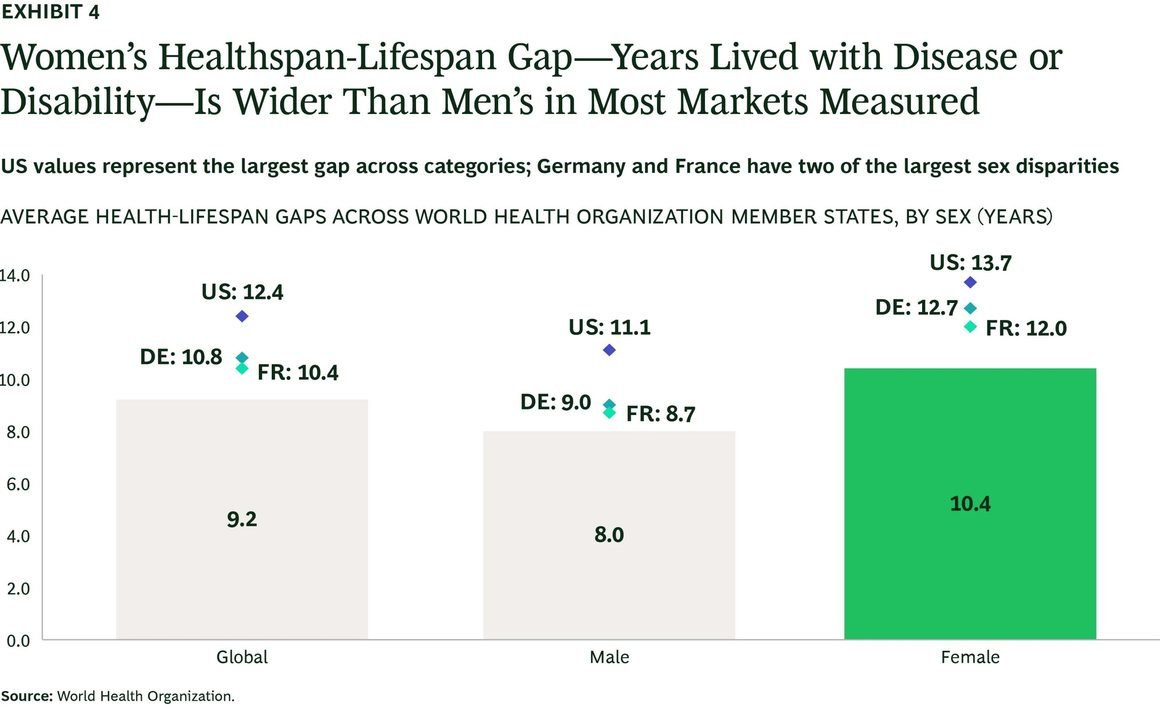
In developed nations, this gap is remarkably wide. For instance, women in the United States live an average of 13.7 years in poor health, compared to 11.1 years for men. This leaves women with an additional 2.6 years of ill health during their final decades.
In European countries, the gap grows even larger. Women in Germany live through 3.7 more years of poor health than men, while in France the gap stands at 3.3 years. These figures show that under present conditions, living longer comes with a heavy physical toll that could be prevented with better-targeted care.
High Effort Without Real Satisfaction
When people face ongoing physical discomfort, they actively search for solutions. Individuals try new diets, daily supplements, wellness routines, and medical therapies because they want to feel energetic and preserve their independence.
Women going through midlife hormonal changes show an extraordinarily high drive to test new wellness solutions. In a global survey covering twelve countries (including the US, the UK, Germany, France, China, and Japan) with 10,608 participants, women in this transition tried health solutions at rates 15 to 22 percentage points higher than other adults. On average, they tested 3.3 more health remedies than younger women and 2.9 more than men.
Despite all this effort and expense, overall satisfaction remains stuck at around 50% across the board. In the US, 90% of menopausal women tested health products like supplements, yet only 35% reported that those products actually met their needs. Trying dozens of options has not led to better health outcomes, proving that the market is offering trial and error rather than real solutions.
The Missed Early Warning Window
Most wellness programs and product developers focus on midlife as the starting point for healthy aging. They assume that major body changes happen suddenly later in life, ignoring the long runway leading up to those years.
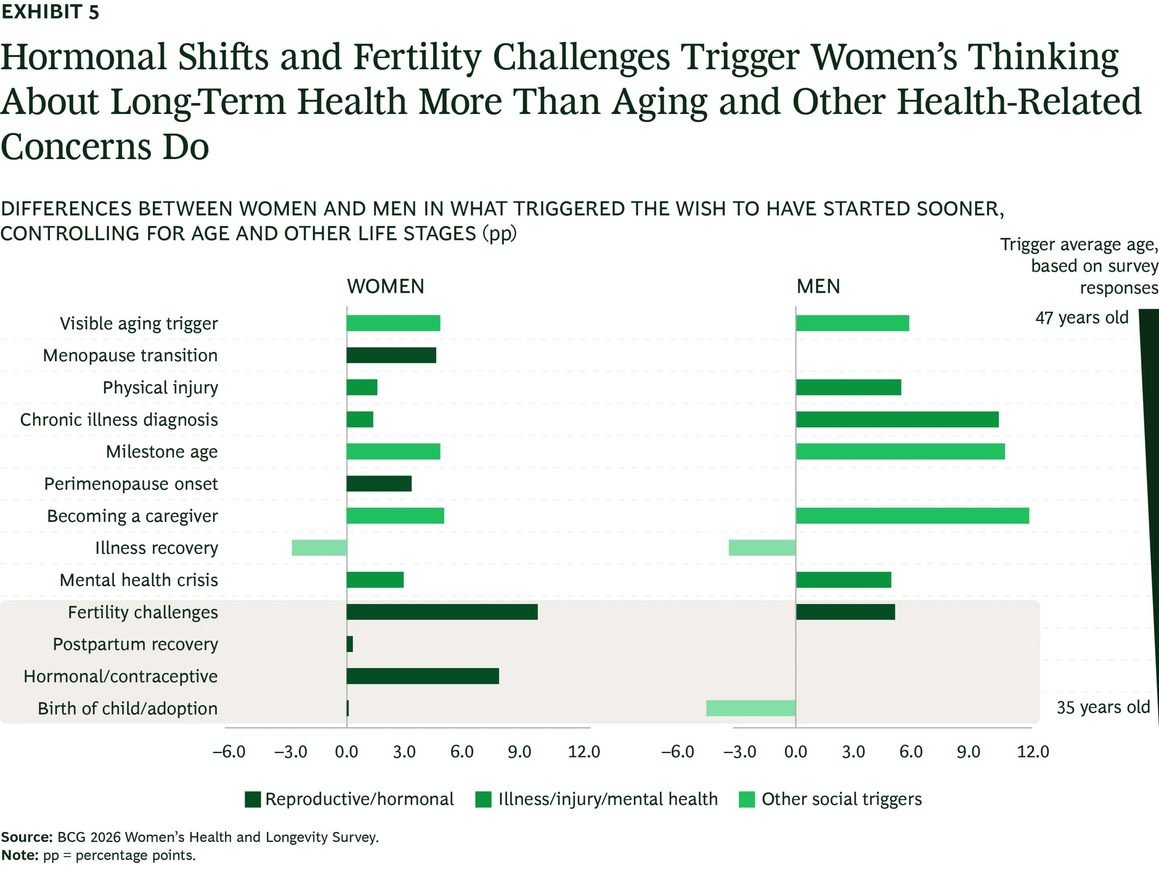
Female body changes occur in distinct stages rather than a slow, linear decline. Important health shifts begin long before midlife. Events such as contraceptive changes, hormonal shifts, and fertility challenges usually occur around ages 36 to 38.
These early life events increase a person’s focus on long-term health by 8 percentage points, which is nearly double the 5 percentage point increase triggered by midlife changes. Men typically do not experience similar health focus triggers until a decade later. Focusing only on midlife misses a crucial ten-year window when preventative habits could dramatically improve future health.
The Sudden Biological Reset
Unlike gradual biological changes, midlife hormonal shifts take place within a narrow and turbulent time frame. This compressed window alters multiple health systems at once, resetting a person’s overall physical trajectory.
During perimenopause, which typically lasts between four and eight years, rapid hormonal changes directly impact heart health, bone density, brain function, and emotional well-being. Treating this period as a minor series of short-term symptoms completely overlooks how deeply it reshapes the body.
Failing to support the body during this biological reset creates long-term risks for major conditions like osteoporosis and heart disease. Protecting vital organs requires comprehensive medical support during this transition rather than superficial, short-term fixes.
Gaps in Medical Training and Care
Healthcare systems struggle to handle specialized hormonal transitions because standard medical training barely covers them. When doctors are not trained to recognize these biological shifts, patients are left without clear answers or effective treatment plans.
In the US, only 31% of gynecology residency programs include any formal curriculum on midlife hormonal transitions. Even worse, fewer than 7% of resident physicians in family medicine, internal medicine, and gynecology feel properly prepared to care for patients experiencing these changes.
This lack of training leads directly to patient dismissal. While 78% of women consult doctors for cardiovascular issues like high cholesterol, only 63% seek help for hormonal conditions like polycystic ovary syndrome, endometriosis, or menopause. Among those who do seek medical care for hormonal issues, only 72% feel taken seriously, compared to 85% who feel listened to when discussing heart symptoms.
Decades of Exclusion from Medical Research
Modern medical knowledge rests on clinical trials that historically excluded women. For generations, medical treatments, drug dosages, and health guidelines were developed based almost entirely on male body chemistry.
Women were completely and systematically excluded from clinical drug trials until 1993. More than thirty years after rules were changed to require their inclusion, women still make up only about 40% of clinical trial participants in the US.
This ongoing historical imbalance leaves major gaps in healthcare. Women account for 60% of the overall burden for psychiatric conditions, 51% of cancer cases, and 49% of heart disease cases. Continuing to design treatments without equal research representation puts health and lives at risk.
The Massive Unmet Spending Demand
People are eager to invest personal funds into their health when they believe a product will truly help them stay active and independent. High out-of-pocket spending shows a strong, active demand for health tools that deliver real benefits.
Women navigating midlife health transitions already spend more out-of-pocket money on health solutions than any other group, spending a median of $84 per month. This compares to $68 per month for women in other life stages and $73 per month for men.
Even with that current spending, about one-third of these women state they would willingly spend an additional $108 every month if effective products actually existed. Across an estimated 1 billion menopausal women globally who are actively seeking wellness tools, this represents an untapped $350 billion economic opportunity for effective health solutions.
Science and Trust Over Marketing Promises
Consumers are increasingly tired of flashy marketing, trendy buzzwords, and unproven wellness promises that fail to deliver lasting relief. Real value comes from products that are backed by solid scientific evidence and clinical testing.
The single strongest factor driving purchasing decisions for midlife health products is a direct recommendation from a trusted doctor or healthcare provider. People want solutions that offer proven results, minimal side effects, and clear physical improvements.
Products that earn medical endorsements and undergo real scientific validation build long-term consumer trust. Companies that invest in proper clinical research will replace gimmicks with meaningful solutions that genuinely improve daily life.
Expanding Institutional Coverage and Access
Relying entirely on out-of-pocket spending restricts access to quality care, leaving millions of individuals without the support they need. Broader institutional backing is essential to make effective health solutions affordable and widely available.
Insurance providers and corporate benefit programs can play a transformative role by expanding coverage for specialized treatments and preventative therapies. When employers offer comprehensive health benefits that address unique biological transitions, employees experience less physical stress and fewer financial hurdles.
Broader insurance coverage also helps legitimate healthcare companies reach more people, creating a stronger market for reliable treatments. Aligning insurance coverage with actual biological needs creates better health outcomes for individuals and lowers long-term medical costs for society.
The Power of Diverse Leadership in Healthcare
Innovation and scientific focus are heavily shaped by the people who make decisions. For decades, longevity research, medical investment, and healthcare leadership have been dominated by male decision-makers.
Increasing female representation among scientific researchers, investors, corporate leaders, and medical founders is essential for closing health gaps. Leaders who understand these health challenges firsthand are far more likely to fund, research, and develop solutions that address long-overlooked needs.
Organizations that champion inclusive research and leadership will set higher standards for the entire health industry. By aligning scientific progress with true biological needs, society can transform aging from a long struggle into a healthy, fulfilling period of life.